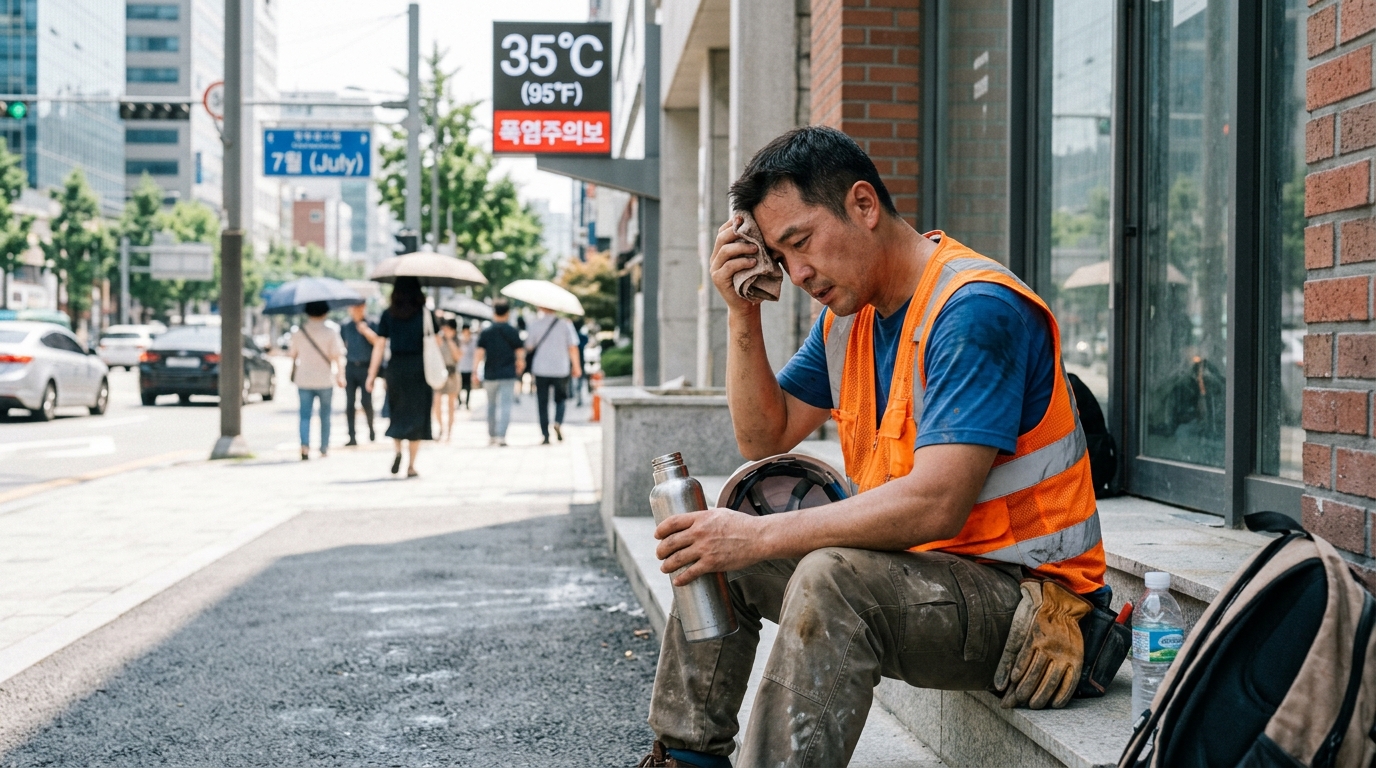
Eighty-six degrees. On paper that's an ordinary summer afternoon — not a number that scares anybody.
And yet that's right where people start going down. Every year, the season's first real heat wave fills emergency rooms with folks who were "just outside for a couple of hours" — landscapers, roofers, warehouse crews, athletes at preseason practice, plenty of them in their twenties with nothing wrong with them. Heat illness doesn't check your age or your fitness level first.
Read to the end and you'll know the warning signs your own body sends before things get serious — and exactly how to spend the three minutes before the ambulance shows up when someone near you collapses.
- Early-summer heat is more dangerous than late-summer heat at the same temperature, because your body hasn't acclimatized yet.
- Heat exhaustion and heat stroke are two different problems. Confusion, slurred speech, or strange behavior means heat stroke — call 911, no debating it.
- Don't hand a collapsed person a water bottle first. Shade and cooling come before fluids.
Why early summer is the most dangerous stretch
Most people assume the middle of August is when things get scary. The pattern says otherwise.
Your body adapts to heat gradually — a process called acclimatization. Over roughly one to two weeks of repeated exposure, you start sweating sooner, sweating more, and losing less salt in the process. So when a mild June flips into a week of 95°F in early July, your body takes the first hit completely unprepared. That's why 86 degrees in June or early July is a different animal from 86 degrees in mid-August.
The tracking data lines up with that. Emergency-department visits for heat illness don't climb steadily all summer — they spike hardest during the first sustained heat wave of the season, often more than doubling inside of a week, then settle down even as the thermometer keeps climbing.
The pattern is starkest among outdoor workers. OSHA has found that roughly three out of four heat-related deaths on the job happen during a worker's first week, and a large share of those on the very first day. New hires, seasonal crews, and anyone coming back from vacation are all in the same boat: the first few days are the gauntlet.

Heat exhaustion vs. heat stroke — what's actually different
Most people lump it all together as "getting overheated." But heat exhaustion and heat stroke are different conditions with different responses, and mixing them up is how families lose people.
If you can't tell them apart, you end up thinking "they just need to sit down for a minute" while the window for treatment closes. The single most decisive signal is mental status.
Sweating buckets, wrung out, dizzy, but talking to you and making sense? That leans heat exhaustion. Sweating stopped, skin hot and dry or flushed, speech slurred, saying things that don't track, seeing things, seizing? That's heat stroke.
Heat stroke means the body's temperature regulation has failed outright. Left too long, it leads to central nervous system damage and multi-organ failure. It's a true emergency, on par with a stroke or a heart attack.
| Heat exhaustion | Heat stroke | |
|---|---|---|
| Mental status | Alert, oriented | Confused, disoriented, incoherent, seizing |
| Skin & sweat | Pale, clammy, cold sweat | Often hot and dry; sweating has stopped |
| Main symptoms | Dizziness, weakness, nausea, muscle cramps | Very high core temperature, neurological symptoms |
| What to do | Rest in a cool place, fluids, electrolytes | Call 911 immediately — ER |
Memorize the bottom row and you're halfway there. When the early signals show up — headache, dizziness, nausea, muscle cramps, cold sweat — stop and get in the shade instead of pushing through. That's the cheapest insurance there is against heat exhaustion turning into heat stroke.
Someone collapses: the three minutes before the ambulance
The question I hear most is "shouldn't you get water into them right away?" That instinct is exactly the dangerous part.
Forcing fluids on someone whose mental status is off risks it going down the airway. Flip the order. Cooling comes before drinking.
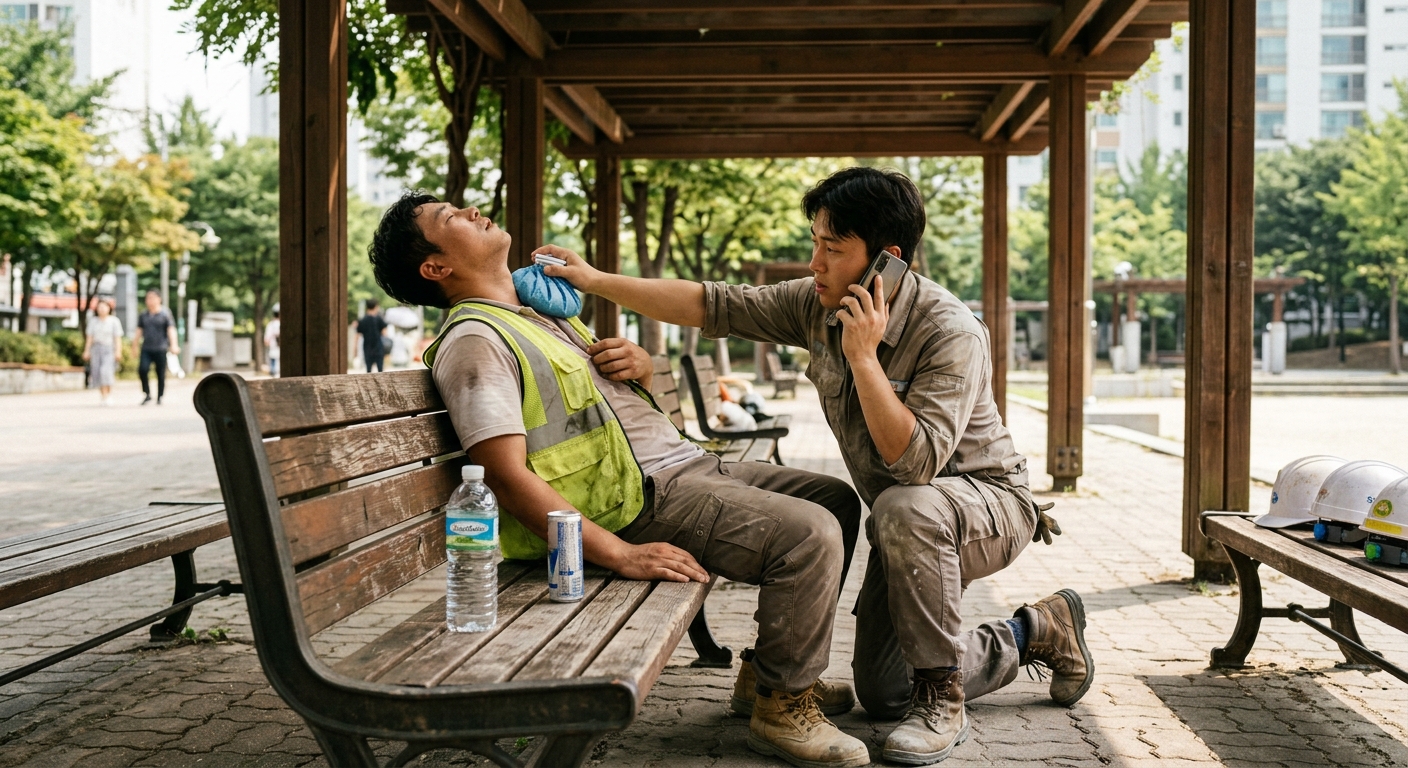
Call 911 without hesitating if you see any of this: altered mental status, seizure, vomiting that won't stop, severe collapse, or anything that looks like heat stroke. The minutes you spend waiting on the ambulance are the ones that shape the outcome — cool aggressively the whole time.
- Move them into deep shade or an air-conditioned space.
- Loosen or remove tight and heavy clothing, including boots and gear.
- Wet the skin down and fan them — evaporation pulls heat off fast. If you can get them into a tub, pool, or stock tank of cold water, that's the most effective cooling of all.
- Pack ice or cold packs at the neck, armpits, and groin to chill the large blood vessels.
- Only if they're fully alert, give small sips of cool water. If they're not, don't put anything in their mouth.
Everyday habits that protect you and your family
Heat illness isn't evenly distributed. Adults 65 and older account for the largest share of heat deaths in the U.S., and outdoor workplaces — construction sites, farms, landscaping crews, delivery routes — account for a big chunk of the rest.
What surprises people is how many heat deaths happen indoors. Apartments and mobile homes with no air conditioning, or with a unit the resident can't afford to run, turn into ovens overnight and never cool off. Being inside is not the same as being safe.
The highest-risk groups: older adults, anyone managing heart disease, diabetes, or kidney disease, people on diuretics or certain psychiatric medications, pregnant women, infants and toddlers, and outdoor workers. Once the heat index climbs past about 100°F — the range where the National Weather Service starts issuing heat advisories — mortality risk in the 65-plus group rises noticeably.
None of the fixes are dramatic. Here's what's worth doing today.
- Drink before you're thirsty. Thirst is already a late signal.
- Shift outdoor work and workouts out of the peak window — roughly noon to 5 p.m.
- Ease into it. The first few days of a heat wave, or your first days back on a job site, cut the intensity deliberately.
- On advisory days, call the older relative or neighbor who lives alone. One phone call.
- The moment your body feels "off," stop. Get somewhere cool and stay there.
One thing to do today
Heat illness isn't bad luck. It's what happens when the warning signs get ignored. Just taking seriously that people go down at 86 degrees puts you halfway to being prepared.
And heat season isn't one bad week in August — public health agencies track it from mid-May clear through the end of September. There's no stretch where it's safe to stop paying attention.
If you do one thing right now: fill a water bottle and put it somewhere you'll actually reach for it. Then, if there's a heat advisory in your area today, text or call the parent or neighbor who's riding it out alone and ask how they're holding up. That one check-in is sometimes the whole difference.