You know the routine. Saturday morning, coffee in hand, you type "Korea with kids" into the search bar, scroll past five nearly identical lists, and close the tab without deciding anything. The same handful of places keeps surfacing, and none of them tell you whether the place will actually work for your kid.
So here are five family-friendly destinations in South Korea — coast, highlands, history, and tradition — each with a clear personality, sorted by season and by what you want out of the trip. I'll also flag which family each one suits, since that's the part the listicles skip. Everything here is current as of July 2026.
The short version, up front:
- Want a thrill? Dojaebigol Sky Valley in Donghae, on the east coast. Want history with river time built in? Yeongwol.
- Escaping August heat? The Daegwallyeong highlands, sitting around 2,600 feet (800 m) up. Want tradition and slow mornings? Sancheong.
- Trying to make history finally click for your kid? Gyeongju — an entire city that works as an open-air museum.
What It Actually Feels Like to Walk Out Over the Ocean — Dojaebigol Sky Valley, Donghae
Dojaebigol Sky Valley sits in Mukho, a hillside port neighborhood in the city of Donghae, on Korea's east coast in Gangwon Province — roughly three hours from Seoul by train or car, which makes it a comfortable weekend target. "Dojaebi" is the regional Gangwon pronunciation of dokkaebi, the horned trickster goblin of Korean folklore. The name fits the place: a steep fishing village of painted alleys and lighthouse views, stacked above very blue water.
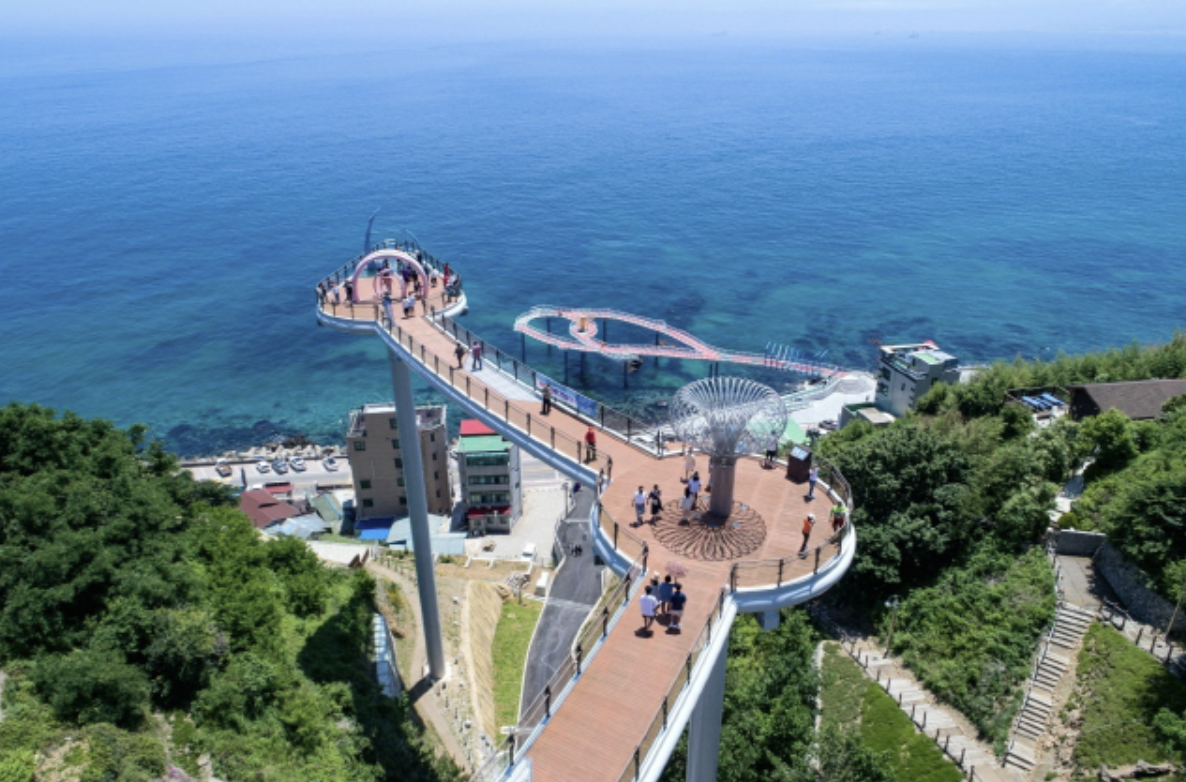
The headliner is a 194-foot (59 m) skywalk that runs dead straight out toward the water. Long stretches of the floor are tempered glass, so you're looking through your sneakers at open air. That's about 20 stories up, standing on a single pane. The involuntary clench in your legs is the entire attraction.
Right beside it, a 280-foot (85 m) pedestrian bridge called Haerang Observatory — designed after the dokkaebi's magic club — continues out over the sea. Walk both and you've collected the whole coastline, open in every direction, in under an hour.
| Detail | Info |
|---|---|
| Location | Mukhojin-dong, Donghae, Gangwon Province (beside Mukho Lighthouse) |
| Main draw | 194 ft (59 m) skywalk with glass-floor sections; 280 ft (85 m) Haerang Observatory bridge |
| Pair it with | Mukho Lighthouse, Nongoldam-gil mural village |
Family tip: The lighthouse and the mural village are both walkable from here, so the three together make a tidy half-day. If one of your kids is afraid of heights, there's a solid-deck route around the glass sections — no negotiation required. Let them set the pace and nobody ends the morning in tears.
The River Island Where a Teenage King Was Exiled — Yeongwol
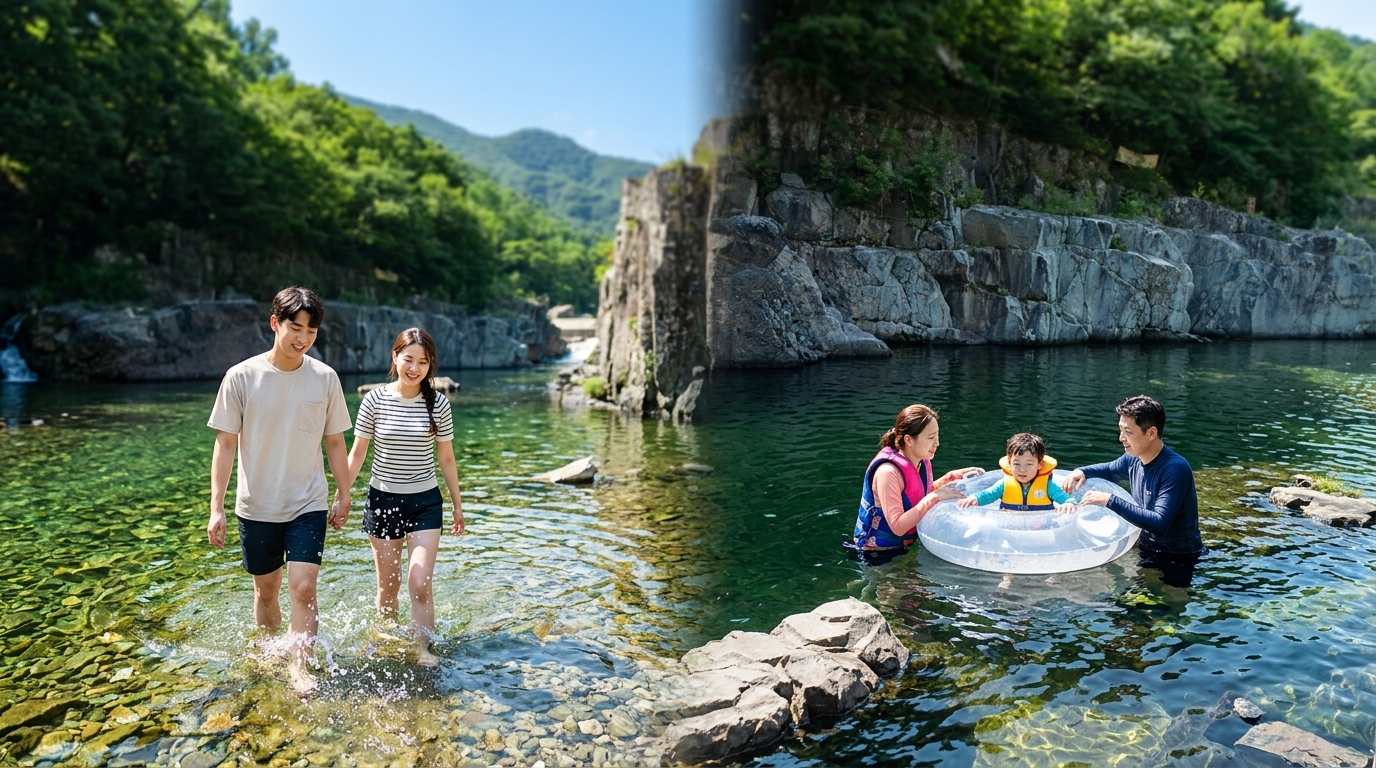
Yeongwol, a couple of hours inland from Donghae, is where three clear rivers — the Donggang, Seogang, and Pyeongchang — braid together through steep green mountains. The sights are strung out along the water rather than clustered downtown, which is exactly why it works: you get nature and history in the same day without choosing.
Start with Cheongnyeongpo. This is where Danjong, the sixth king of the Joseon dynasty, was banished in 1457 after his uncle seized the throne from him as a teenager. The site is ringed by river on three sides and sealed off on the fourth by a wall of cliffs, so the only way in is still by ferry boat — a genuine island of a place, and a very effective way to explain the word "exile" to a nine-year-old.
It's been protected as Scenic Site No. 50 since 2008 (Korea's designation for landscapes of outstanding beauty, roughly the equivalent of a U.S. National Natural Landmark). Inside you'll find the king's restored quarters, a pine tree several centuries old, and a small stone cairn he's said to have built while looking toward home. Nearby, Gosigul Cave is a limestone cave some 400 million years in the making — named, according to local lore, for the Go family who sheltered inside it during the Japanese invasions of the 1590s.
| Attraction | What makes it worth the stop |
|---|---|
| Cheongnyeongpo | King Danjong's place of exile; Scenic Site No. 50; reached only by ferry boat |
| Gosigul Cave | 400-million-year-old limestone cave; wartime refuge legend |
| Donggang & Pyeongchang rivers | Whitewater rafting, hand-pulled cable ferries, wading |
Family tip: For most kids, the ferry ride is the attraction — the history lands better once they've crossed water to get there. Come in summer and add a half-day of rafting on the Donggang; outfitters run family floats with tamer stretches for younger children.
A Day on a Ranch Above the Clouds — Daegwallyeong
Daegwallyeong is a 2,730-foot (832 m) mountain pass straddling the line between Pyeongchang — yes, the 2018 Winter Olympics host — and the coastal city of Gangneung. It leads a double life: cool-air escape in summer, snow country in winter. Ridgeline wind turbines standing over grazing pasture and ski runs give it a look you won't find anywhere else in the country.
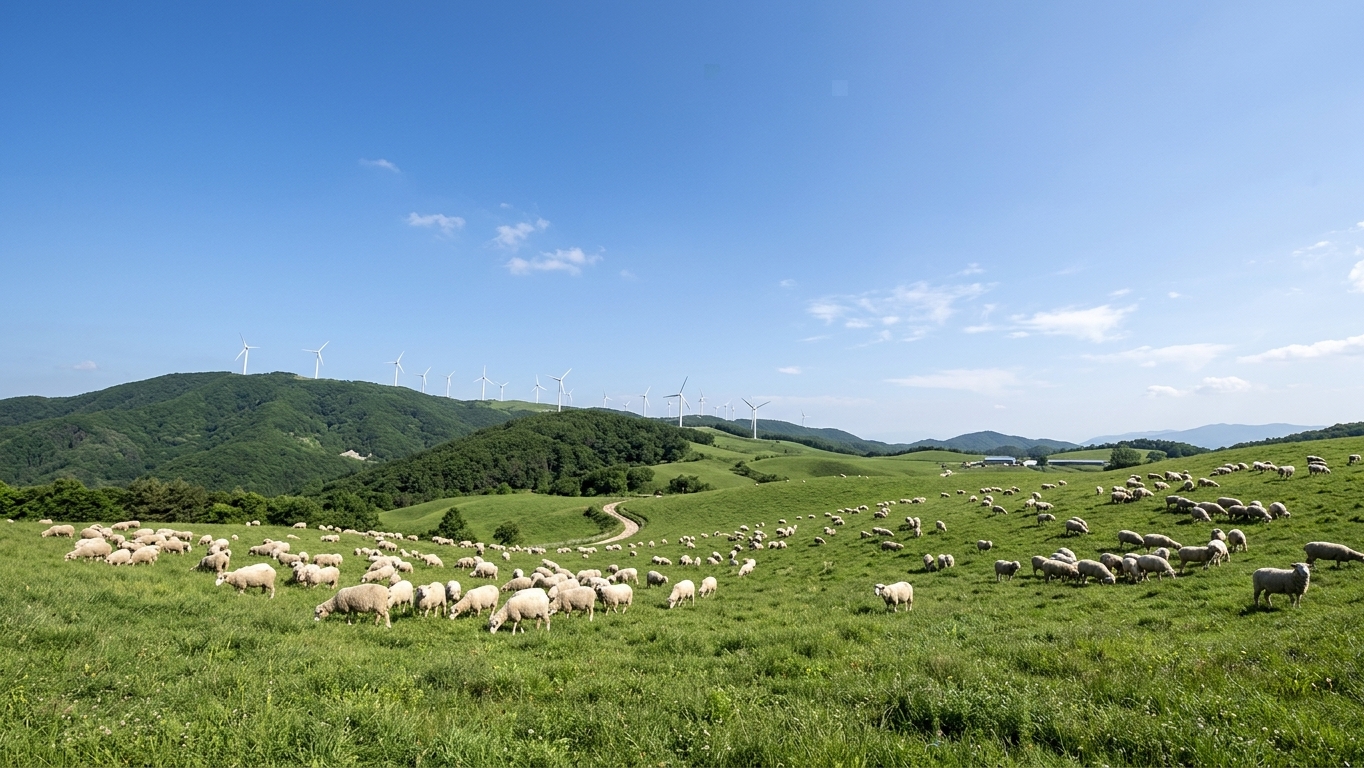
Because it sits so high, Daegwallyeong routinely runs 10–15°F (5–8°C) cooler than Seoul in midsummer, which is the entire reason Korean families flood up here in August. The area's three big ranches sit close together along the same ridge, so the question isn't which ones to visit — it's which single one to pick.
- Samyang Roundhill (formerly Samyang Ranch) — enormous, sweeping, shuttle-served. Near the summit you stand almost underneath the wind turbines.
- Sky Ranch — established in 1974 and closed to the public for four decades before opening in 2014. A tractor-drawn wagon hauls you up to the Haneulmaru overlook.
- Daegwallyeong Sheep Farm — the smallest of the three, and the most hands-on: a short loop trail and a feeding pen where kids get eye-level with the sheep.
| Ranch | Character |
|---|---|
| Samyang Roundhill | Huge scale, up-close wind turbines, big views |
| Sky Ranch | Tractor wagon ride, ridge-top overlook |
| Daegwallyeong Sheep Farm | Sheep feeding, short easy walking loop |
Family tip: With toddlers and preschoolers, the Sheep Farm usually wins — short distances, animals within arm's reach. Grade-schoolers tend to prefer the sheer scale of Samyang Roundhill. Commit to one before you leave the hotel; trying to do two in a day means most of it happens in the car. Bring layers either way — the wind up there has teeth even in July.
Stone Walls and Slow Hours — Sancheong, in the South
Sancheong tucks into the foothills of Jirisan, the mainland's highest mountain and the heart of Korea's largest national park. It's known for clean air and for herbal medicine, and it's an easier day trip from Busan (about two hours) than from Seoul. The place to start is Namsa Yedam Village.
This is a preserved traditional village of hanok houses behind earth-and-stone walls, some of the lanes barely wide enough for two people. It's routinely named one of the most beautiful villages in Korea, and deservedly. There's not much in the way of organized activity here — you walk the curving walls, peer into courtyards, rent a hanbok if the mood strikes, and the centuries quietly fall away. For families used to theme parks, that emptiness is the point.
Sancheong has harvested medicinal herbs from Jirisan's slopes for centuries, which earned it a reputation as the home of traditional Korean medicine. Donguibogam Village turns that heritage into something closer to a theme park: a medicine museum, herbal treatment rooms, and exhibition halls. It's named for the Donguibogam, the 17th-century Korean medical encyclopedia now listed in UNESCO's Memory of the World register — think of the whole tradition as a cousin of Chinese herbal medicine, with its own distinct canon. Kids get to smell, sort, and grind actual herbs, which beats reading a placard.
| Attraction | What makes it worth the stop |
|---|---|
| Namsa Yedam Village | Traditional stone-walled lanes, historic hanok homes, hanbok rentals |
| Donguibogam Village | Traditional-medicine theme park, herb and treatment experiences |
| Jirisan foothills | Hiking, swimming holes, working herb farms |
Family tip: Namsa Yedam Village in the morning, Donguibogam Village in the afternoon makes one full day. Add a valley swimming hole up toward Jirisan and you've got a genuinely good overnight.
A City That Reads Like a Textbook — Gyeongju
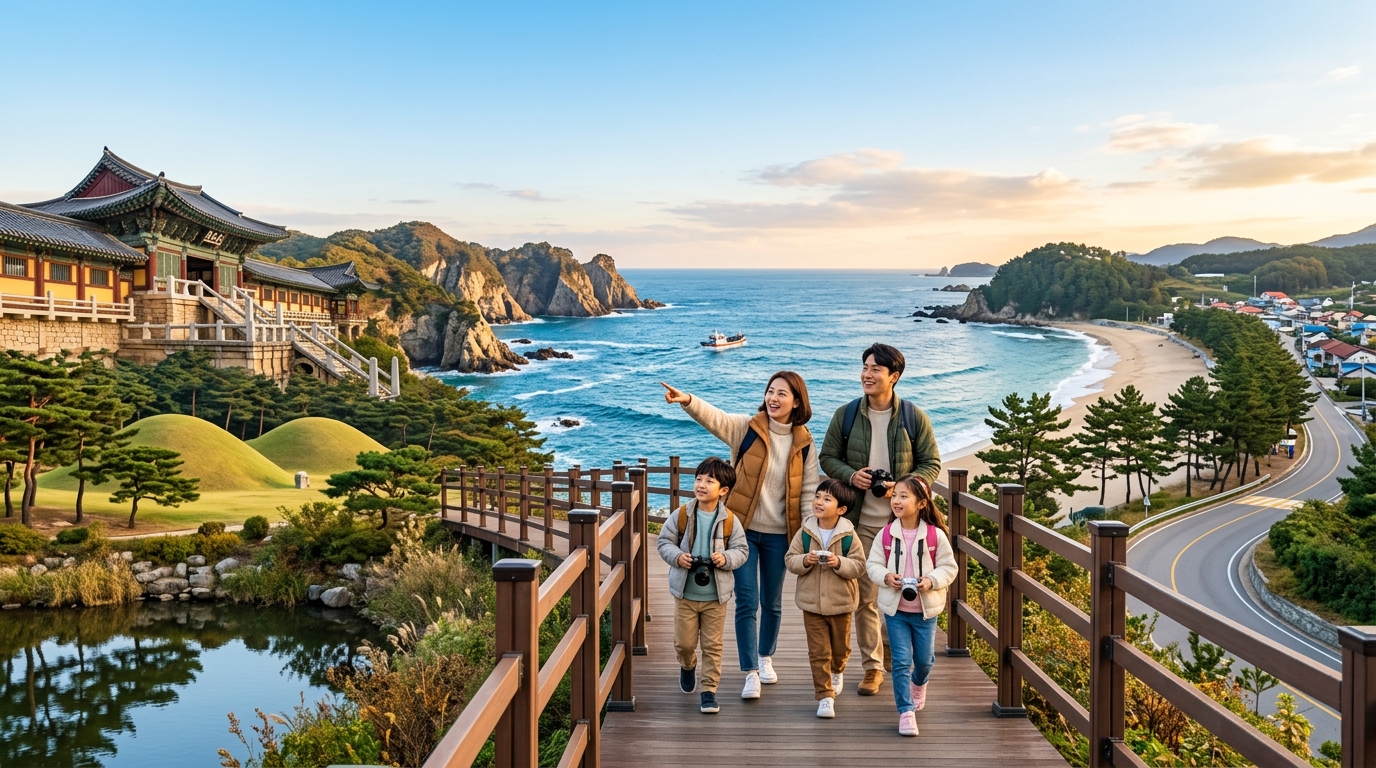
Gyeongju was the capital of the Silla kingdom for roughly a thousand years, and the evidence is everywhere — tombs in traffic circles, pagodas behind parking lots. Koreans sometimes call it the Kyoto of Korea; the Rome comparison works too. It's about two hours from Seoul on the KTX high-speed train, and it's the single best place in the country to show a kid history instead of assigning it.
Lead with Bulguksa Temple and the Seokguram Grotto. Bulguksa spreads across the lower slopes of Tohamsan; Seokguram is a precision-engineered artificial stone chamber holding a single seated Buddha. Both were inscribed as UNESCO World Heritage sites in 1995. The Gyeongju Historic Areas — covering Cheomseongdae, the Daereungwon tomb complex, and Namsan mountain — followed in 2000. Two separate World Heritage listings in one small city says most of what you need to know.
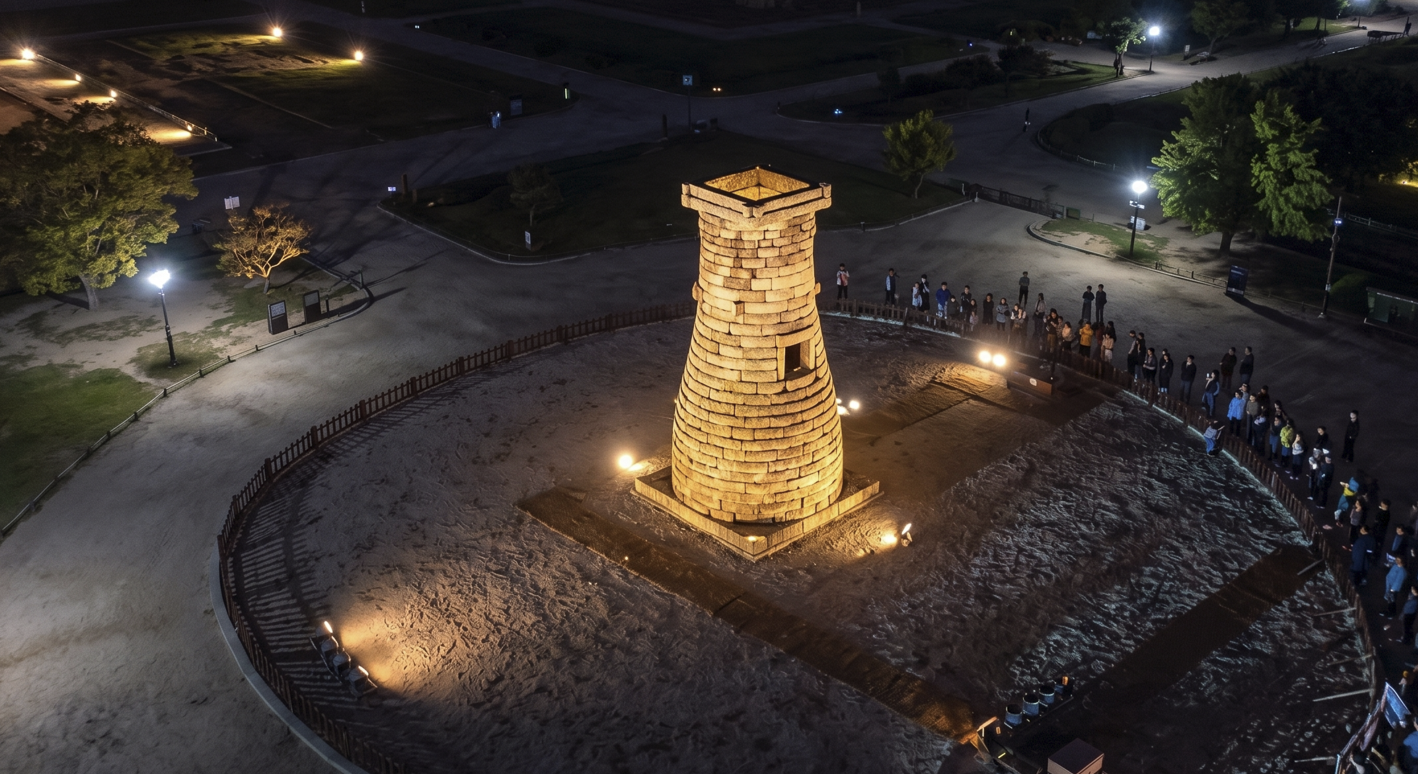
Downtown, within easy walking distance of each other, are Cheomseongdae — the oldest surviving astronomical observatory in East Asia — and Daereungwon, where the burial mounds of Silla kings and nobles rise out of the lawns like grassy hills you're not allowed to climb. Here's the detail that hooks most kids: Silla was the eastern terminus of the Silk Road, and Roman glassware has been excavated from these very tombs. Something made near the Mediterranean ended up buried here, and you can go see it in the national museum the same afternoon.
| Attraction | What makes it worth the stop |
|---|---|
| Bulguksa & Seokguram | UNESCO World Heritage, inscribed 1995 |
| Cheomseongdae | Oldest surviving astronomical observatory in East Asia |
| Daereungwon | Royal Silla burial mounds, walkable downtown park |
Family tip: Do Bulguksa and Seokguram by day, then walk the Daereungwon mounds and Cheomseongdae after dark, when both are floodlit. Same city, two completely different moods, one day. Rent bikes downtown if your kids are old enough — the historic core is flat and made for it.
So Which One Is Yours? All Five at a Glance
Lined up side by side, the choice gets a lot easier.
| Destination | Region | Theme | Best for families who want |
|---|---|---|---|
| Dojaebigol Sky Valley | Donghae, Gangwon Province | Ocean, thrills | An adrenaline hit with a sea view |
| Yeongwol | Yeongwol, Gangwon Province | History, rivers | History delivered outdoors, plus rafting |
| Daegwallyeong | Pyeongchang & Gangneung | Highlands, ranches | Cool air, big scenery, farm animals |
| Sancheong | Sancheong, South Gyeongsang | Stone walls, herbal medicine | Tradition and a slower pace |
| Gyeongju | Gyeongju, North Gyeongsang | Ruins, ancient history | History their kid will actually remember |
Five places is more than one trip can hold, so don't try. Open the calendar this weekend and settle on a single sentence instead: we want the ocean, or we want out of the heat, or we want our kid to stand in front of something two thousand years old. The moment that sentence exists, your destination is already somewhere on this list.