
You ran the AC maybe seven hours a day, nothing wild, and then the bill lands at $380. Meanwhile your neighbor swears they run theirs just as much and pays half that. Infuriating.
Here's the thing: the culprit is almost never how long you ran it. It's the rate tier — or the peak window — you crossed. Below I'll walk through how tiered and time-of-use electricity pricing actually works, the one number on your bill worth memorizing, the free fixes you can make this afternoon, and the rebate program that pays you exactly nothing unless you sign up for it.
- Nearly every US utility charges more per kWh in summer, and a lot of them stack tiers on top. Cross your allowance and every extra kWh gets billed at the priciest rate on the sheet.
- Bill shock isn't about hours — it's about crossing a line. Find your summer tier ceiling, stay under it, and most of the damage disappears.
- 78°F, ceiling fans, a clean filter, and not short-cycling a variable-speed system covers most of it. Then go enroll in your utility's rebate or demand-response program.

Why summer bills blow up — and it isn't just the heat
Tiered pricing is simple in principle: the more you use, the more each kilowatt-hour costs. Utilities in California, Arizona, Georgia and plenty of other states bill residential customers in steps — the first chunk of kWh is cheap, the next chunk costs more, and anything past the top threshold gets the most expensive rate on the schedule. That top-tier rate can run well over 1.5x what you pay in Tier 1.
Summer is brutal because of one appliance. A household that cruises along at 900 kWh a month suddenly clears 1,400 kWh once the AC runs daily — and every one of those extra kWh lands in the top tier. That's how you end up saying "my usage went up 50% but my bill nearly doubled."
And if you're on a rate plan with a demand charge — common with Arizona and some Southwest utilities — it gets more unforgiving. Demand charges bill you on your single highest hour of the month, not your total. Run the dryer and the oven while the AC is cranking at 6 p.m. one Tuesday and that one hour sets a fee you pay for the entire billing cycle. Same for time-of-use plans: a kWh used at 5 p.m. can cost triple what it costs at 11 a.m. Two houses, same seven hours of AC, completely different bills.
The one number worth memorizing: your summer tier ceiling
Most utilities publish a higher baseline allowance for the summer season than for winter and shoulder months — the steps get wider, so it takes more usage to hit the expensive rate. Here's what that structure typically looks like side by side.
| Tier | Off-season allowance | Summer season (June–Sept) |
|---|---|---|
| Tier 1 (lowest rate) | First 500 kWh | First 700 kWh |
| Tier 2 | 501–1,000 kWh | 701–1,350 kWh |
| Tier 3 (most expensive) | Above 1,000 kWh | Above 1,350 kWh |
Those numbers are illustrative, not your numbers. Baseline allowances vary wildly by utility and by climate zone — a house in Phoenix gets a much bigger summer allowance than one in coastal Oregon. Pull up your rate schedule (search your utility's name plus "residential rate schedule" or look for "baseline allowance" on your bill) and write your own ceiling on a sticky note.
One misconception worth clearing up: a wider summer allowance does not mean cheaper electricity. The per-kWh rates are usually higher in summer. All that's happening is the threshold moves later.
Say you use 1,350 kWh in August. Under the off-season structure above, 350 of those kWh would get hit with the top-tier rate. Under the summer allowance, those same 350 kWh stay in Tier 2. That gap is your entire savings — nothing more, nothing less.
Which is why the benefit is so uneven. A household that runs 600 kWh a month barely notices, because they were sitting in the cheap tier either way. The households that win big are the ones hovering right around the line. Rates get adjusted by regulators every year or two, so always confirm current numbers with your utility.
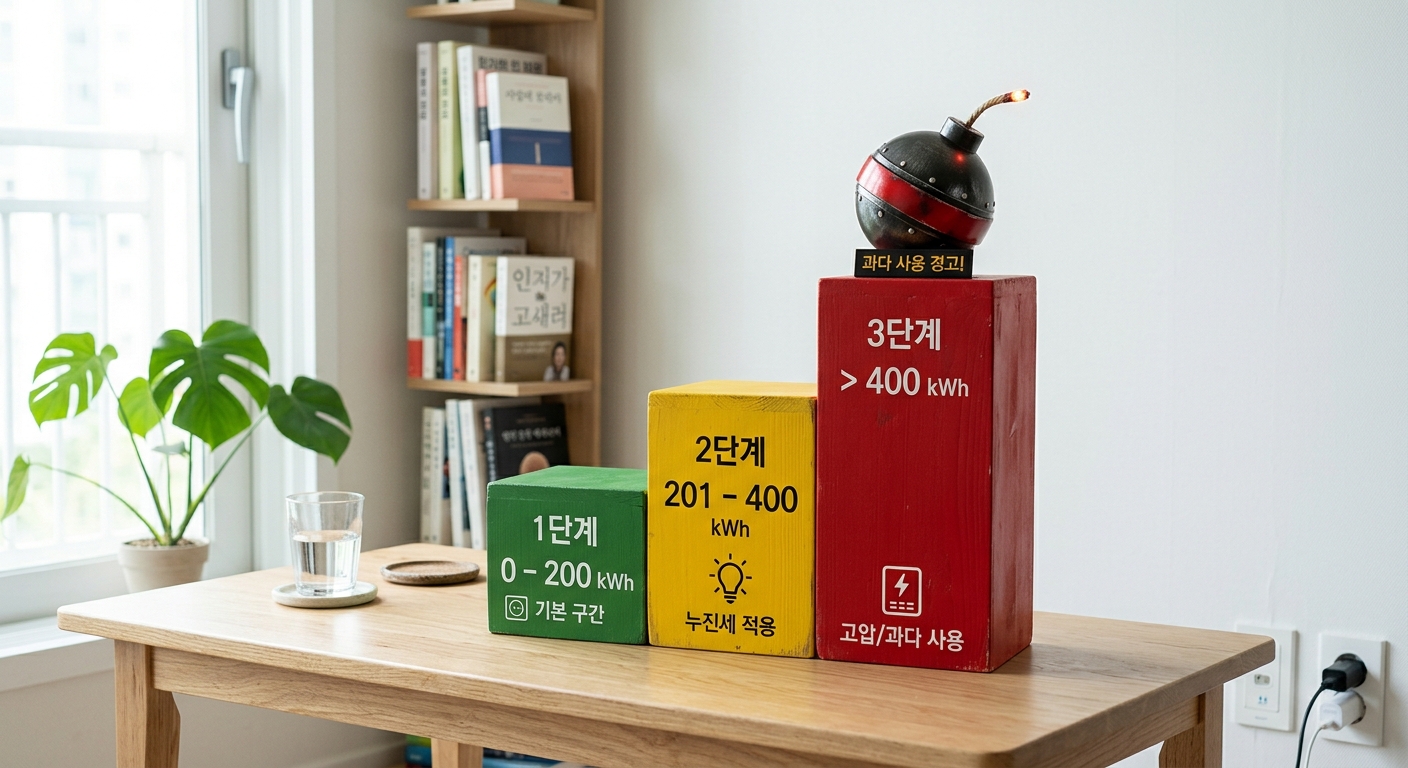
What different usage levels actually feel like
These aren't exact bill amounts — they're here to give you a feel for where the steps sit. Your real charges will differ.
- 600 kWh — comfortably in the bottom tier for most households. This is roughly what a family of four uses in April or October with the AC off.
- 900 kWh — right about the US household average. Most of it still prices at the lower tiers thanks to the wider summer allowance. This is a home running the AC a few hours a day with some restraint.
- 1,400 kWh — you're into the top tier now, and the bill jumps noticeably. In my experience this is exactly where people start using the word "insane" about their utility.
See the trap? Going from 900 to 1,400 kWh is only about 1.5x the usage. But that extra 500 kWh is priced entirely at the most expensive rate on the schedule, so what you actually pay climbs much faster than that. Which makes managing your monthly total near the tier line the whole ballgame.
Free things you can do today to get back under the line
Staying under the threshold means shaving the total, a little at a time. Here's everything that costs nothing and works starting right now.
- Set the thermostat to 78°F (26°C). That's the Department of Energy's recommendation for when you're home and awake, and every degree you nudge it up saves roughly 3% on cooling. Flip that around: every degree you drop costs you the same.
- Run ceiling fans alongside the AC. Moving air makes a room feel about 4°F cooler, so you can set the thermostat higher without noticing. Just turn fans off when you leave — they cool people, not rooms.
- Deal with the filter. Swap a central AC filter every 1–3 months during heavy use, and rinse mini-split filters monthly. A clogged filter can push energy use up 5–15%, and rinsing takes five minutes.
- Program a night setback. Letting the temperature drift up a few degrees overnight beats running full blast until morning, and most people sleep through it fine.
- Block afternoon sun. Close blinds and curtains on west- and south-facing windows before the heat hits. Stopping the room from warming up is cheaper than cooling it back down.
- Clear the outdoor condenser. Two feet of clearance on all sides, no trash cans or shrubs crowding it, and hose the coils off. Restricted airflow tanks efficiency.
Concretely: a family of four running about 1,450 kWh a month can usually drop 60–100 kWh just by raising the setpoint a degree or two, running fans, and adding an overnight setback. That lands them back around 1,350 — just barely under the top tier. Feels like nothing, right? Those two or three habits are the entire difference between one step and the next.
Leaving for a couple hours: shut it off or let it run?
The answer flips depending on what kind of system you have, so check yours first. Look for "variable-speed" or "inverter" on the outdoor unit's label or in the manual — ductless mini-splits and most heat pumps installed in the last decade are variable-speed, while older ducted central AC is usually single-stage.
Variable-speed (inverter) systems and mini-splits
These throttle down to low output once they hit your setpoint instead of shutting off entirely. That makes steady-state running more efficient than flipping it on and off repeatedly, since every restart means ramping back to full power. Cool the space down aggressively when you first turn it on, then hold somewhere in the 78–82°F range. If you'll be gone more than a few hours, though, still shut it down or bump the setpoint way up.
Single-stage central AC
Single-stage units only know one speed: full blast. They already cycle on and off on their own, so there's no efficiency penalty to setting the thermostat back when you leave — and DOE guidance is clear that setbacks save money on conventional systems. Program it, don't think about it.
The money you only get if you ask for it
Most utilities run some version of a demand-response or peak-time-rebate program, and the marketing around them is genuinely confusing. It's not a discount on your rate. It's a bill credit for cutting usage during a handful of announced peak events each summer — typically a few hours on the hottest afternoons, a handful of times a season. Credits usually run a few dollars per event, sometimes more.
The bar is lower than people think. Precooling the house before the event window, holding off on the dryer, and killing phantom loads is often enough to qualify. Programs like Nest Rush Hour Rewards will even handle the thermostat adjustment automatically, and many utilities throw in a smart thermostat rebate ($50–$125, sometimes the whole unit) on top.
Here's the part that matters: seasonal rate changes and tier allowances apply to your account automatically. Rebate programs do not. You have to enroll. Log into your utility account, search for "demand response," "peak time rebate," or "summer savings," and click through it once. Three minutes, and after that it runs itself.
Find out where you stand right now
The single best defense against a surprise bill is knowing your number today, not on the 30th. Almost every utility now has an app or online dashboard showing month-to-date usage and a projected bill, and if you have a smart meter you can see it broken out by day or even by hour. You'll need your account number from the bill to register.
Check it around the middle of the month. That's when you can still do something about a "we're on pace to blow past the line" situation. If your utility supports Green Button data export, you can download your interval usage and see exactly which days spiked. Honestly, just watching the number climb changes how you behave — it did for me.
If you only do one thing today
To recap: the whole game is knowing which pricing tier you're currently sitting in. Look up your summer allowance, write the number down, and manage your monthly total under it. That alone prevents most bill shock.
And if you only do one thing today, enroll in your utility's rebate program. It takes three minutes, and it's the only money on this list you cannot get retroactively. If you'd rather open August's bill and think "huh, less than I expected" instead of feeling your stomach drop, today's three minutes is what buys you that.
Do summer tier allowances change every year?
They can. Baseline allowances and per-kWh rates are set in filed rate schedules and get revised by state regulators, sometimes more than once a year. Treat any number you read online — including the examples above — as a rough guide and confirm the current one on your utility's rate schedule or bill.
Is it ever actually cheaper to leave the AC running?
With a variable-speed or inverter system, often yes. Once it reaches the setpoint it idles at low output, so holding a steady temperature can beat repeatedly shutting it down and forcing a full-power restart. With conventional single-stage central AC, setting back the thermostat while you're out saves money. Either way, if you'll be gone several hours, turn it off or set it way up.
Why doesn't my actual bill match these example numbers?
Because a bill is more than kWh times a rate. You're also paying a fixed monthly service charge, delivery charges separate from supply charges, fuel or purchased-power adjustments, taxes and local franchise fees, and possibly a demand charge. Billing cycles also vary from 28 to 33 days, which shifts your total. Use the examples here to understand the tier structure, and your actual bill for actual dollars.
Do I have to enroll in rebate and demand-response programs?
Yes. Tier allowances and seasonal rates apply automatically to every account, but rebate and demand-response credits require you to sign up. You can usually enroll through your utility's website or app, and sometimes directly through a smart thermostat's manufacturer.