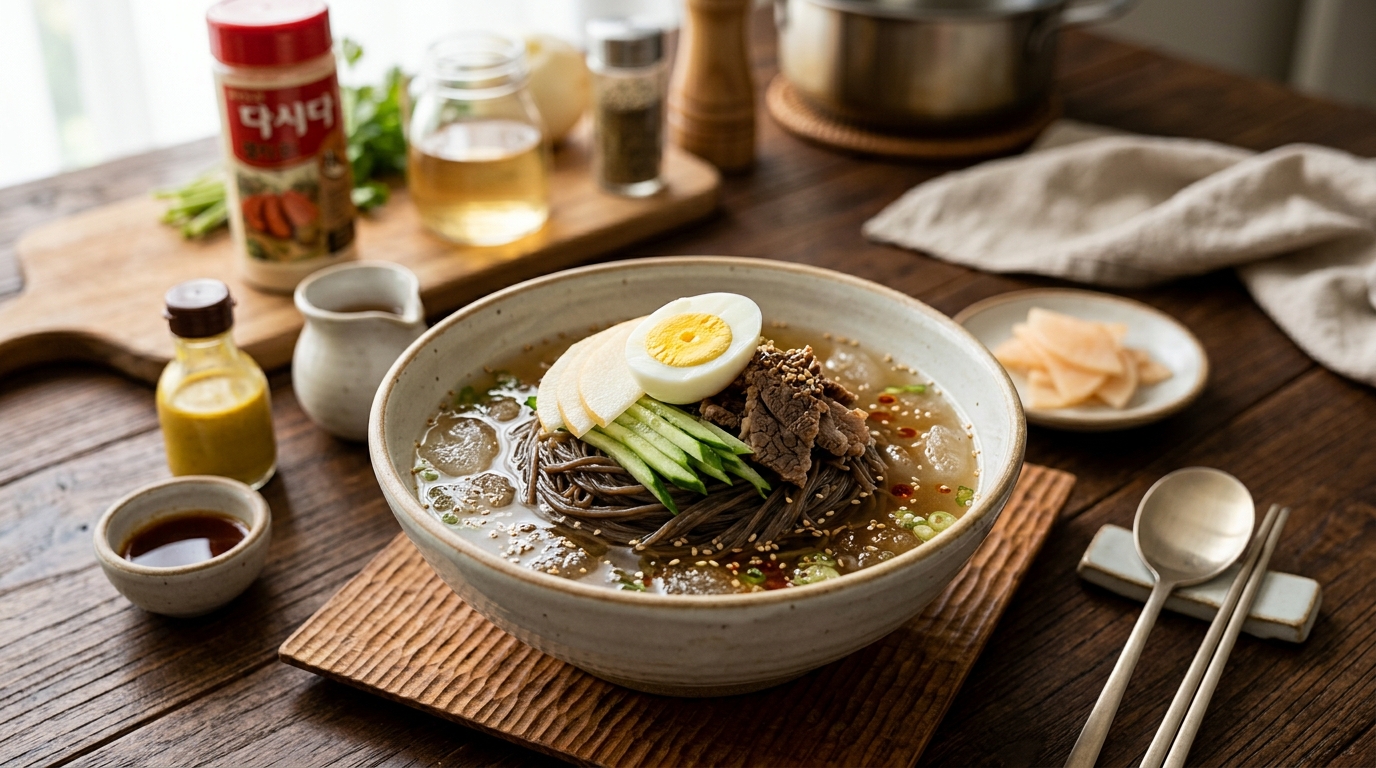
You know the moment: you open the front door after work in July and a wall of hot air rolls out to meet you. On nights like that, cooking dinner feels impossible, but the thought of a bowl of icy mul naengmyeon — Korean cold buckwheat noodles swimming in slushy, tangy broth — will not leave you alone. And nobody is simmering beef bones for four hours in August.
So here's what I landed on: a naengmyeon broth built on one packet of Dashida, done in 10 minutes, with ratios that work every time. (Dashida is the Korean beef stock seasoning powder in the yellow packet — you'll find it at H Mart or any Korean grocery, and on Amazon. It's essentially bouillon powder with a heavy hand of savory umami.) There's no real secret here. Just one thing: you make the broth twice, in two parts, and combine them.
- A concentrated Dashida broth plus a clean, barely-seasoned water broth, mixed together — the saltiness gets tamed and only the savory depth survives.
- Vinegar goes in after the heat is off. Boil it and that bright, sharp aroma evaporates right along with the steam.
- Freeze the finished broth just until it's slushy, then scrape and pour. That's the crunch you get at a real naengmyeon restaurant.
Why bother making the broth twice?
Dashida is doing two jobs at full volume: savory punch (MSG and nucleotides) and straight-up salt. Dissolve it in water and yes, you get broth — but for something you're supposed to drink to the bottom of the bowl, it lands way too concentrated and too salty.
Scroll the reviews on any "just add Dashida" recipe and the same comment shows up over and over: the umami hits your tongue like a slap. That's the seasoning stepping out in front of everything else.
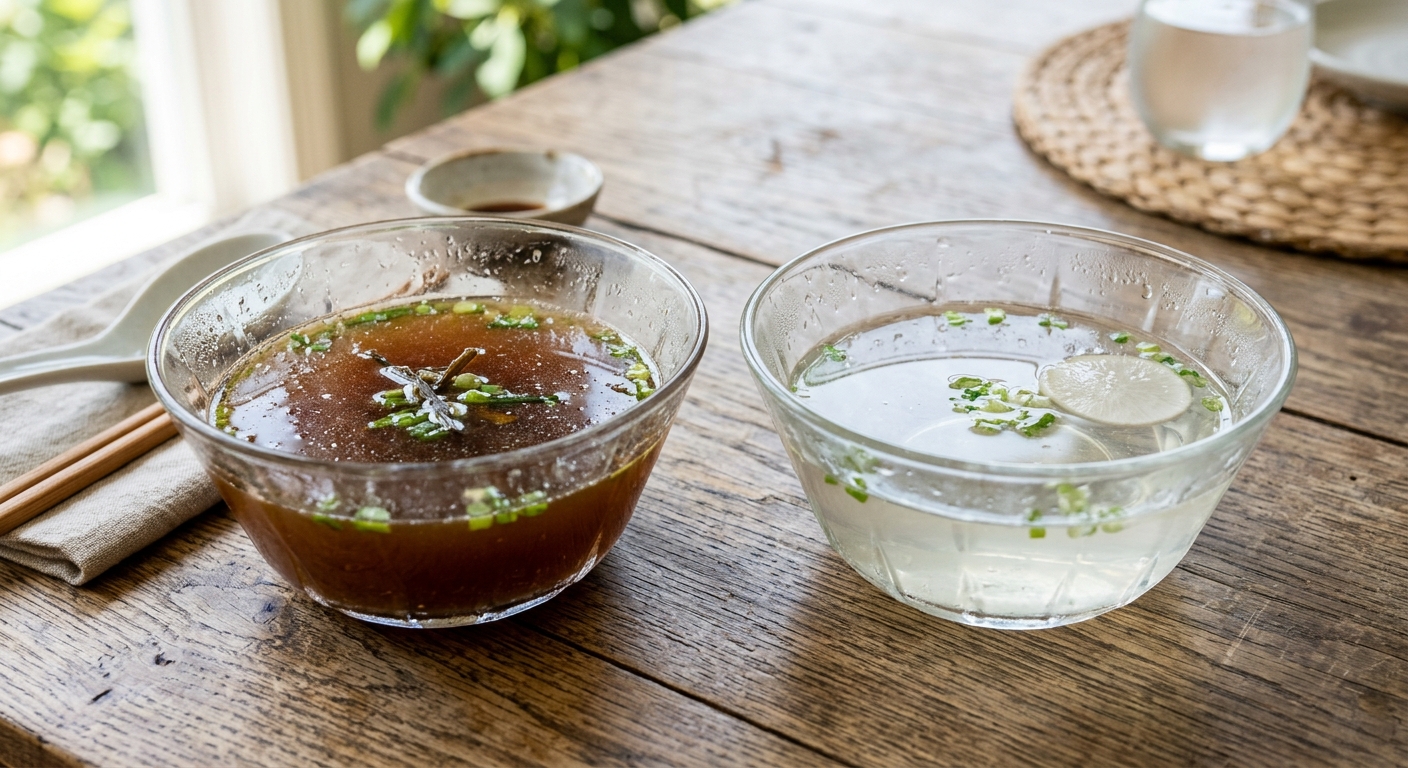
So this method makes a concentrated Dashida broth and a nearly-plain water broth separately, then marries them. The water broth quietly pulls the intensity down while the sweet-tart balance stays exactly where you want it. It's one extra step — and that one step is the difference between "salty seasoning water" and actual naengmyeon broth.
What you'll need (serves 2 · about 800 ml / 3⅓ cups total)
Two tables. The first is the concentrated broth, the second is the water broth. One tablespoon (T) is 15 ml throughout.
① Dashida broth (the concentrated one)
| Ingredient | Amount |
|---|---|
| Water | 500 ml (about 2 cups) |
| Brown sugar | 30 g (about 2½ Tbsp, packed) |
| Dashida beef stock powder | 10 g (about 1 Tbsp) |
| Salt | 3 g (about ½ tsp) |
| Vinegar | 20 ml (1 Tbsp + 1 tsp) |
② Water broth (the clean one)
| Ingredient | Amount |
|---|---|
| Water | 300 ml (about 1¼ cups) |
| Vinegar | 1 Tbsp (15 ml) |
| Sugar | 1 Tbsp |
| Salt | ½ Tbsp |
Nothing exotic on that list. One packet of Dashida, sugar, salt, vinegar, and a single saucepan — that's the whole grocery run. No Dashida on hand? A beef bouillon powder plus a small pinch of MSG gets you close, though the flavor leans a little less rounded.
The 10-minute method
- Boil the Dashida broth — Combine 500 ml water, 30 g brown sugar, 10 g Dashida, and 3 g salt in a saucepan and bring it to a boil.
- Kill the heat, then add vinegar — Once everything has dissolved and it's bubbling, turn off the burner first. Then stir in the 20 ml of vinegar and let it cool.
- Chill it down — Once the steam dies off, move the Dashida broth to the fridge — or the freezer if you're impatient (I usually am).
- Mix the water broth — Stir 1 Tbsp each vinegar and sugar plus ½ Tbsp salt into 300 ml cold water and chill. No cooking required.
- Combine — Pour the two cold broths together. That's 800 ml, a generous two servings.
Cooking for one? The math is easy: 250 ml Dashida broth + 150 ml water broth = 400 ml, exactly one bowl.
Why the vinegar goes in last
The bright, sharp aroma of vinegar comes from acetic acid, and it's fragile under heat. Add it to a boiling pot and that aroma leaves with the steam. You're left with sourness, but not the lift that hits the back of your nose.
So adding it off the heat — a tiny, almost fussy-sounding detail — is what separates a good bowl from a flat one. There's a reason every decent naengmyeon recipe makes a point of the vinegar timing.
Slushy ice and toppings: where the bowl comes together
The soul of naengmyeon is that slushy layer of ice crystals. Put the finished broth in the freezer, pull it out when the edges have just started to set, and scrape it with a spoon as you pour. The perceived cold goes up an entire level.
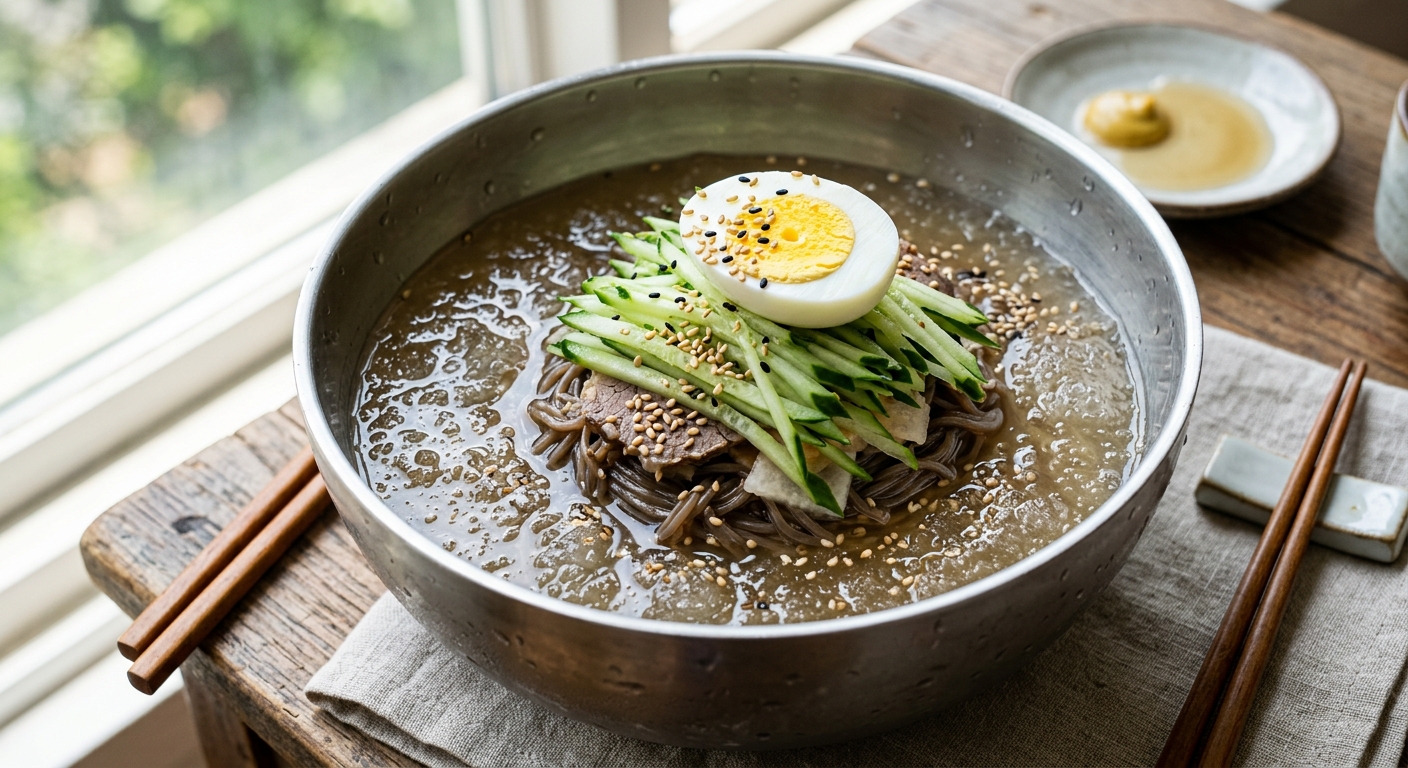
The key is not freezing it solid. A frozen brick can't be scraped. When the edges turn grainy and slushy, that's your window.
Toppings shape the bowl almost as much as the broth does. Even the basics make it read as restaurant food.
- Noodles rinsed in cold water — Wash off the surface starch or you lose the chew.
- Julienned cucumber — Crunch and freshness.
- Half a hard-boiled egg — Softness and staying power.
- A shower of toasted sesame seeds — The nutty finishing note.
- Float a few ice cubes and the last bite is as cold as the first.
From there, add whatever's within reach: thin-sliced boiled beef (pyeonyuk), julienned Asian pear, pickled radish wraps (ssammu, the thin sheets of sweet-sour daikon you get with Korean fried chicken), and a squeeze of Korean hot mustard.
Too salty or too flat? Just read this table
| If this happens | Do this |
|---|---|
| Tastes too salty | Pour in a little more water broth to dilute |
| You want it sharper | Add a splash of vinegar right before eating (never boiled) |
| You'd rather have it as a spicy mixed bowl | Cut way back on the broth and toss the noodles with gochugaru, sesame oil, and sugar |
| Making it ahead | Chill the two broths separately and combine right before serving |
There are really only two dials here. Salty? More water broth. Flat? More vinegar. Remember those two and this doesn't fail.
Tonight, one saucepan is all it takes
No beef bones. No afternoon-long simmer. One packet of Dashida, sugar, salt, vinegar, and a single rule: make it in two parts. If you only remember one thing tonight, make it this — vinegar goes in with the heat off.
On an evening too hot to even want dinner, one saucepan and 10 minutes puts a bowl of slushy, ice-cold naengmyeon in front of you.