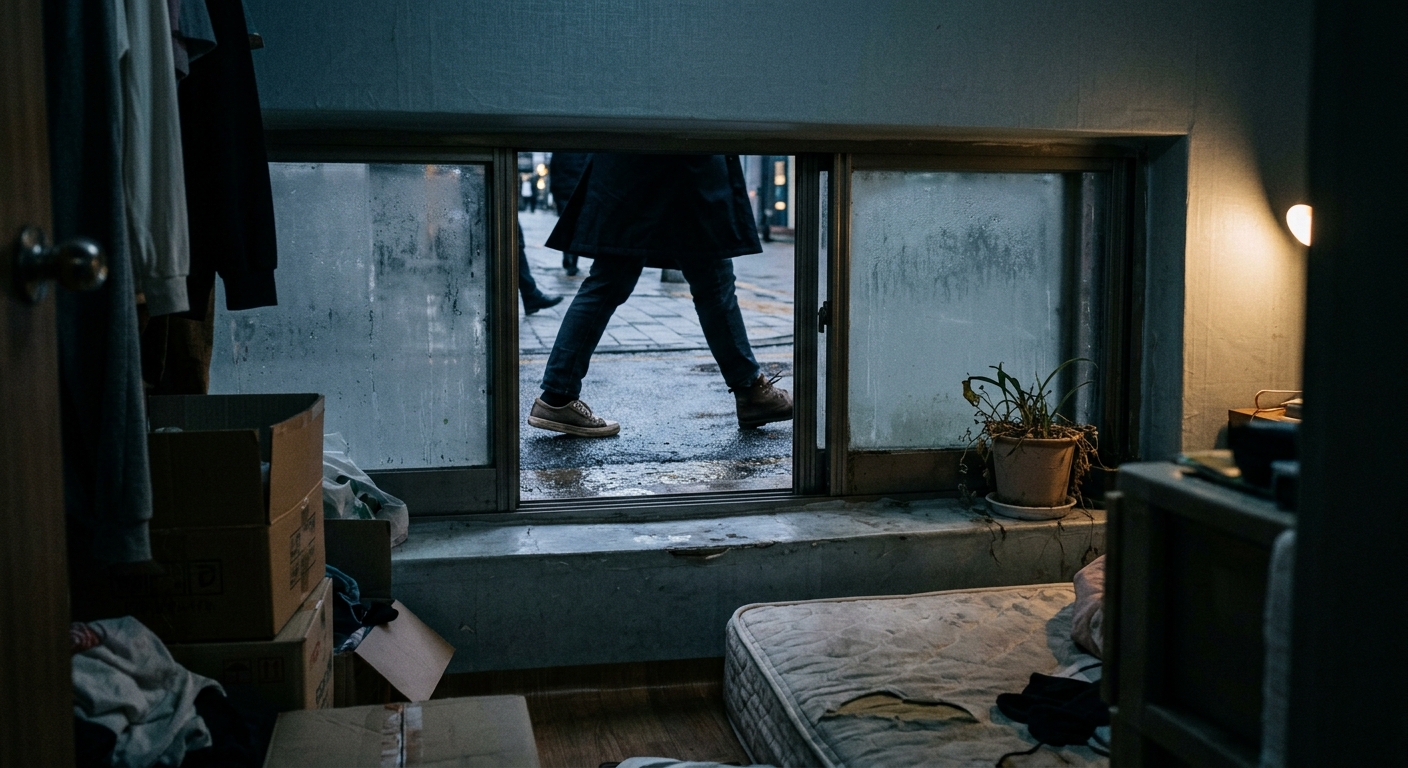
If you've ever straightened up from a box and watched two unfamiliar legs stroll past your window, you know the feeling. That view where you only see people from the knees down. The asymmetry of it — you can't see them, but they can look straight into your living room without even trying.
That's where almost all basement-apartment anxiety starts. The good news: it's also the one thing you can fix tonight. I've sorted these by what a renter can do without leaving a mark on the unit.
If you're short on time, here's the short version.
- The anxiety traces back to one thing — a window sitting flush with the sidewalk. Cover that and the whole apartment feels different.
- On move-in day, the first task isn't unpacking. It's putting film on the glass before you turn a light on.
- Work in this order: privacy film → window security bars → interior-release (quick-release) bars, choosing by cost and how permanent it is.
Why basement windows start at ankle height
In an upper-floor apartment, the window sits at eye level. To see in, someone has to walk right up and stoop. In a garden-level or basement unit, the top of the window is level with the ground outside.
From a passerby's point of view, a slight tilt of the head takes in the entire room. You work to block the view; they get it for free. That imbalance is what makes below-grade living feel different from any other apartment.
The "legs that stopped" story every renter tells
Read enough reviews and tenant threads about basement units and the same scene keeps showing up. First night in the place, boxes still taped shut, you glance at the window — and someone's legs are just standing there.
Nine times out of ten it's a neighbor having a smoke or taking a call on the stoop. But "footsteps passing" and "shoes that stopped" land completely differently.
Footsteps are just traffic. Stopped feet read like intent aimed at you. And people say a single curtain doesn't erase that feeling. That's why the same sentence appears in review after review.
Below-grade living is more common than people think
I'm not here to tell you basement apartments are scary places to live. They're ordinary housing that a lot of people rent, often because it's the version of a neighborhood they can actually afford.
Korea is one of the few places that counts below-grade homes precisely, and its numbers are a useful reference point for the rest of us: as of the 2024 national census, 398,000 households — 1.8% of all homes — live in basement or semi-basement units, over 90% of them in the greater Seoul area. More telling for our purposes: 67.7% of those homes are in buildings more than 30 years old. Garden-level units in older US walk-ups — prewar Brooklyn brownstones, Chicago two-flats, Boston triple-deckers — share exactly that profile.
The older the building, the lower the sill and the flimsier the hardware. So feeling exposed isn't you being paranoid. It's a design problem you inherited with the lease.
- Scale: roughly 398,000 households below grade in Korea (1.8% of all homes), per the 2024 census
- Concentrated in dense cities: 56.9% of them in Seoul alone — expensive metros push housing underground
- Aging stock: 67.7% in buildings 30+ years old, which usually means low sills, painted-shut sashes, and rusted or missing bars
Why "hey, that's someone's home" happens so often
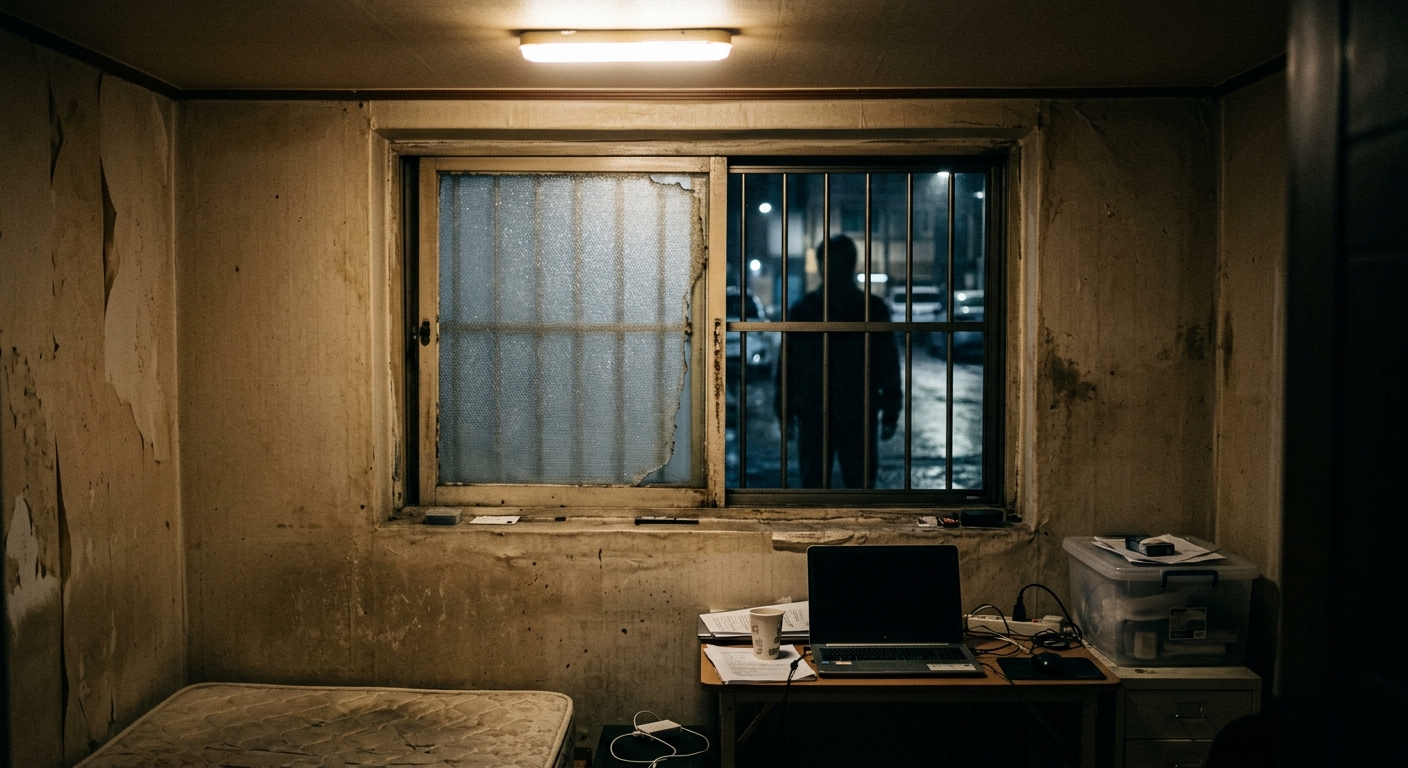
Two lines come up constantly in basement-apartment reviews: "curtains alone don't make me feel safe," and "the second I turn a light on, my silhouette is visible from the street."
The reason is simple. There's no buffer zone. An upper unit has a fence, a yard, a set of stairs between you and the public. A garden-level window is often less than an arm's length from the sidewalk — under three feet.
Turn on a light at night and bare glass becomes stage lighting. Which is why the first thing to deal with in a below-grade unit isn't the boxes or the paint — it's the windows. Just reordering your move-in checklist changes how the first night feels.
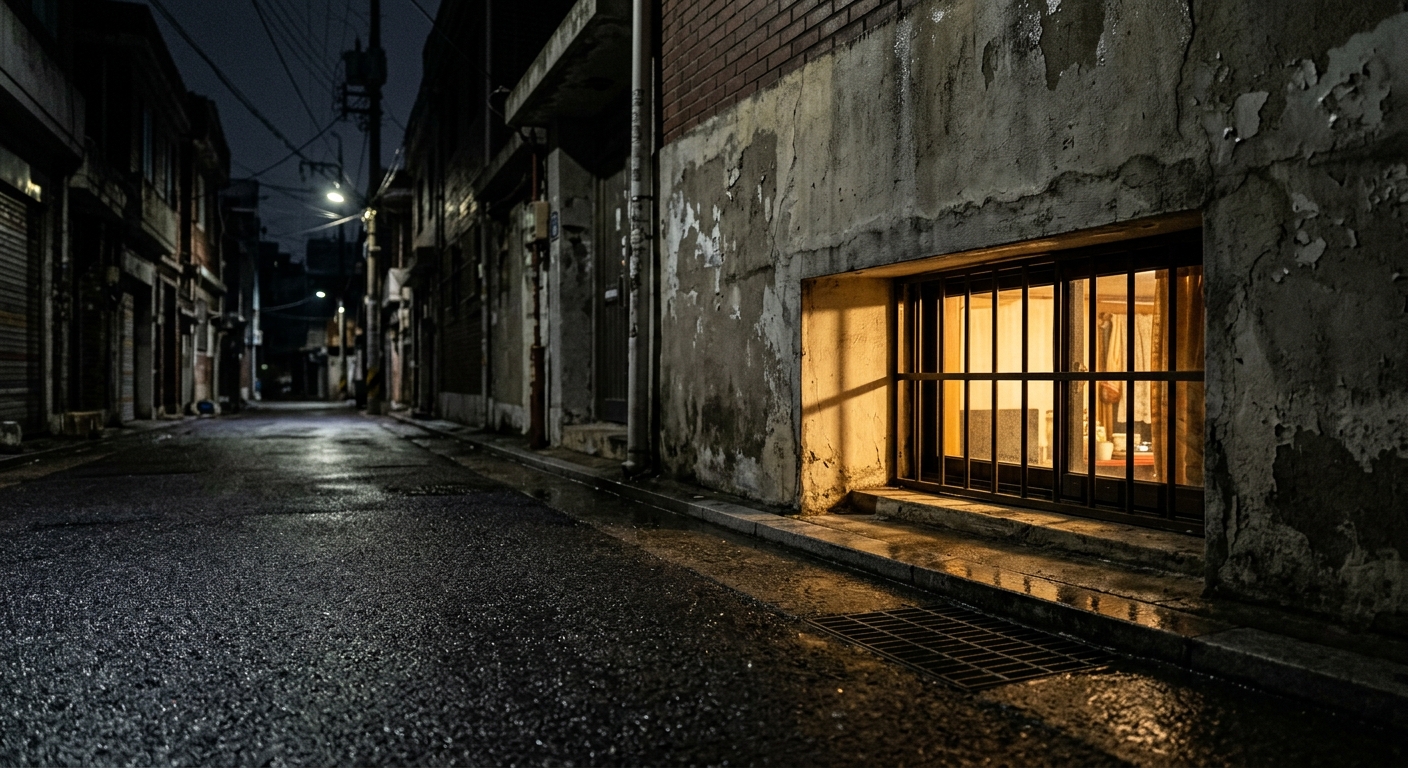
3 ways to secure the window tonight
Here are the options people actually use, sorted by cost and how much of a mark they leave. If you rent, start with the reversible end of the list.
| Option | What it blocks | Worth knowing |
|---|---|---|
| Privacy window film | Sightlines and silhouettes | Renter-friendly, goes on and comes off clean, doable today |
| Fixed security bars / window guards | Break-in attempts | Bolted to the structure — needs landlord approval first |
| Quick-release (hinged) bars | Break-ins plus sightlines | Heavy-gauge, and openable from the inside in a fire |
Tackle them in this order.
- Move-in day: put the film up before you flip a single light switch. It's the fastest way to stop your silhouette from leaking out after dark.
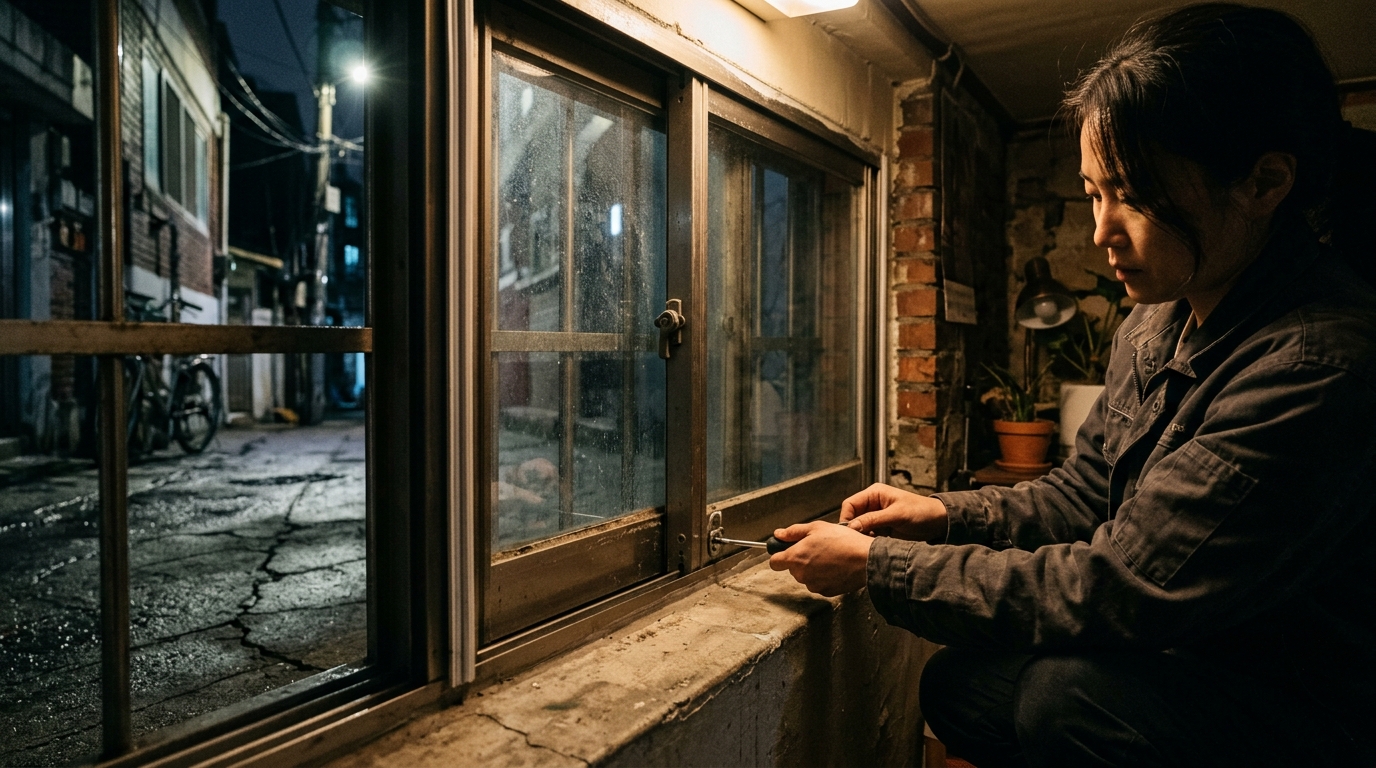
- If the bars are rusted, bent, or missing, ask your landlord to replace or install them. Working window locks and guards are a habitability item in a lot of leases and local housing codes, so this ask lands better than you'd expect.
- If the budget allows, look at quick-release bars. They handle privacy and intrusion at once — just confirm the unit opens from the inside without a key, so you're not blocking your own egress.
One more thing. If it's the footsteps outside the glass that get to you, a small motion-sensor light aimed at the walkway does a lot of work. Knowing the light comes on before anyone reaches your window is its own kind of reassurance.
How to pick privacy film (it's not all the same)
Search "privacy window film" and you'll drown in options. For a below-grade window, only two things really matter.
- Choose for night, not daytime. Standard frosted or one-way film works on a brightness differential — the bright side can't see into the dark side. So it blocks fine at noon and then reverses the moment you turn your lights on. Your silhouette goes right through it. For real nighttime coverage you want an opaque film, or film plus a second layer.
- Cover the whole pane, bottom to top. Filming just the upper half is nearly pointless when the viewing angle is at ground level. The strip closest to the sidewalk is the part that matters most.
Application is easy. Clean the glass, then mist it generously with water and a few drops of dish soap before laying the film on — that lets you reposition it as many times as you need. Squeegee from the center outward to push the bubbles out, wipe the edges with a dry towel, done. It peels off later without residue, which is exactly why it's the right first move for a renter.
Nighttime silhouettes are mostly a lighting problem
If the film is up and you still feel exposed after dark, look at where your lights are. Any bright fixture near the window projects your shadow straight onto the glass.
- Skip the ceiling fixture and use wall-facing indirect light or a floor lamp — far fewer shadows cast on the window.
- Layer your curtains: blackout plus a sheer. Blackout alone leaks light at the edges; a sheer alone lets your outline through.
- Put a piece of furniture or a room divider between the window and your bed or desk. It cuts down the angle anyone can see into.
Worth doing alongside the window itself
Blocking the view and blocking entry are two different jobs. These all skip the contractor.
- Screen latch — window screens usually slide right open by hand. A $3–5 latch changes that.
- Secondary window lock / sash stop — it limits how far the sash opens, so you can vent the room and still be locked. Look for a clamp-on version with no screws; nothing for your landlord to object to.
- Door and window entry alarm — cheap magnetic contact sensors that chirp loudly when separated. The deterrent value of noise beats the actual physical protection.
- Motion-sensor light — great if you can mount it outside the window, though anything on the exterior wall means asking the landlord first.
What to check before you install security bars
Bars are the real deal for intrusion, but you have to weigh the other side: they can block your escape route in a fire or a flood. In a below-grade unit the window is often the only way out, and if water is rising, it's the only way out.
That's the whole argument for quick-release bars you can open from inside over fixed ones. US egress and fire codes generally require exactly that on a bedroom window, so ask about it explicitly. If fixed bars are already in place, at minimum make sure everyone in the household knows how to release them — and don't stack storage in front of that window.
On cost: there's real room to split it with your landlord or ask them to cover it outright, since it reads as a safety and habitability upgrade rather than a decorating preference. When you make the ask, lead with specifics — the bars are rusted through, the latch doesn't catch, the sash won't lock — instead of "it feels unsafe." Concrete beats emotional in a maintenance request every time.
Are curtains really not enough?
During the day they can be. Nights are the problem. Once the room is brighter than the street, a thin curtain passes your silhouette straight through. If curtains are your solution, layer blackout over a sheer and add film to the glass itself. That combination holds up.
What can I do as a renter without asking the landlord?
Anything reversible with no screws is generally fine: privacy film, screen latches, clamp-on sash stops, magnetic entry alarms. Installing or replacing security bars and mounting a light on the exterior wall touch the structure, so those need approval — get it in writing so it doesn't come back at you when you move out.
What's the right order on move-in day?
Windows before boxes — before you turn on a light. Film first, lights second. That single swap makes the biggest difference in how the first night actually feels.
It comes down to reordering your first night
None of this is meant to scare you off a basement apartment. The unease in these units almost always traces back to one spot — the window — and the point I wanted to make is that it's a spot you can fix yourself.
Tonight there's exactly one job. Before you turn on the lights, check whether there's film on the glass. The boxes will still be there afterward.
Those legs outside are almost certainly just a neighbor walking by. But peace of mind only shows up once you're the one who gets to confirm that.