How many times a day do you dig your phone out of your pocket? Once for directions, once to check a text, once more to pull up a translation app. The whole point of the device that just came out from behind the curtain is to delete that motion entirely.
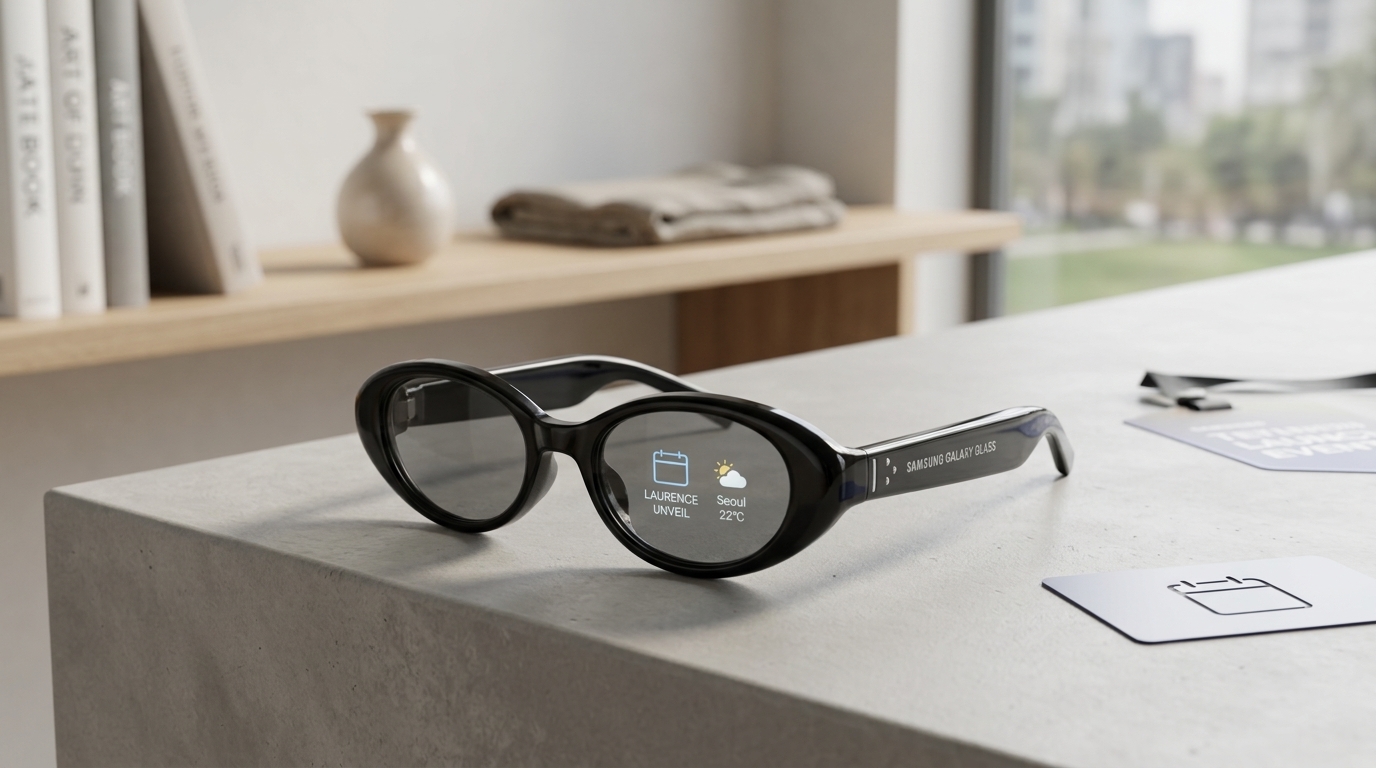
I'm talking about Galaxy Glass, Samsung's first pair of AI smart glasses. Everyone had them pegged for the July Unpacked stage, but Samsung flipped the script and showed them off back in May at Google I/O 2026 instead. Unlike the early renders floating around last year, the actual hardware came in ahead of expectations. Below is everything that's actually confirmed so far, from what changes day to day down to whether it's worth your money.
- What it is: Samsung's first AI smart glasses, unveiled at Google I/O 2026 (as of July 2026)
- Who's building it: Hardware by Samsung, software by Google, silicon by Qualcomm
- Launch and price: Expected this fall, with pricing rumored at $379–$499
Why the audio-only pair ships first
Galaxy Glass isn't one product, it's two tracks. Up first is an audio-only model that delivers everything by sound, with a display model following later.
The audio pair isn't a standalone computer. It's a companion device that rides alongside your phone's AI features. The goal is singular: keep both hands free.
So why sound before visuals? Putting a display in front of your eye eats far more components and far more battery. Shipping the lighter version first and reading the room is the obvious play.
Hardware from Samsung, software from Google, the processor from Qualcomm.
Three companies that move the global tech market, each bringing what they're best at to the same pair of frames.
| Model | How it works | Launch order |
|---|---|---|
| Audio-only Glass | Delivers info through sound | Ships first |
| Display Glass | Puts info in your line of sight | Follows later |
Do they look like gadgets or just like glasses?
The first hurdle for any pair of smart glasses is fit and style. It doesn't matter how good the features are: if they scream "gadget," nobody wears them all day.
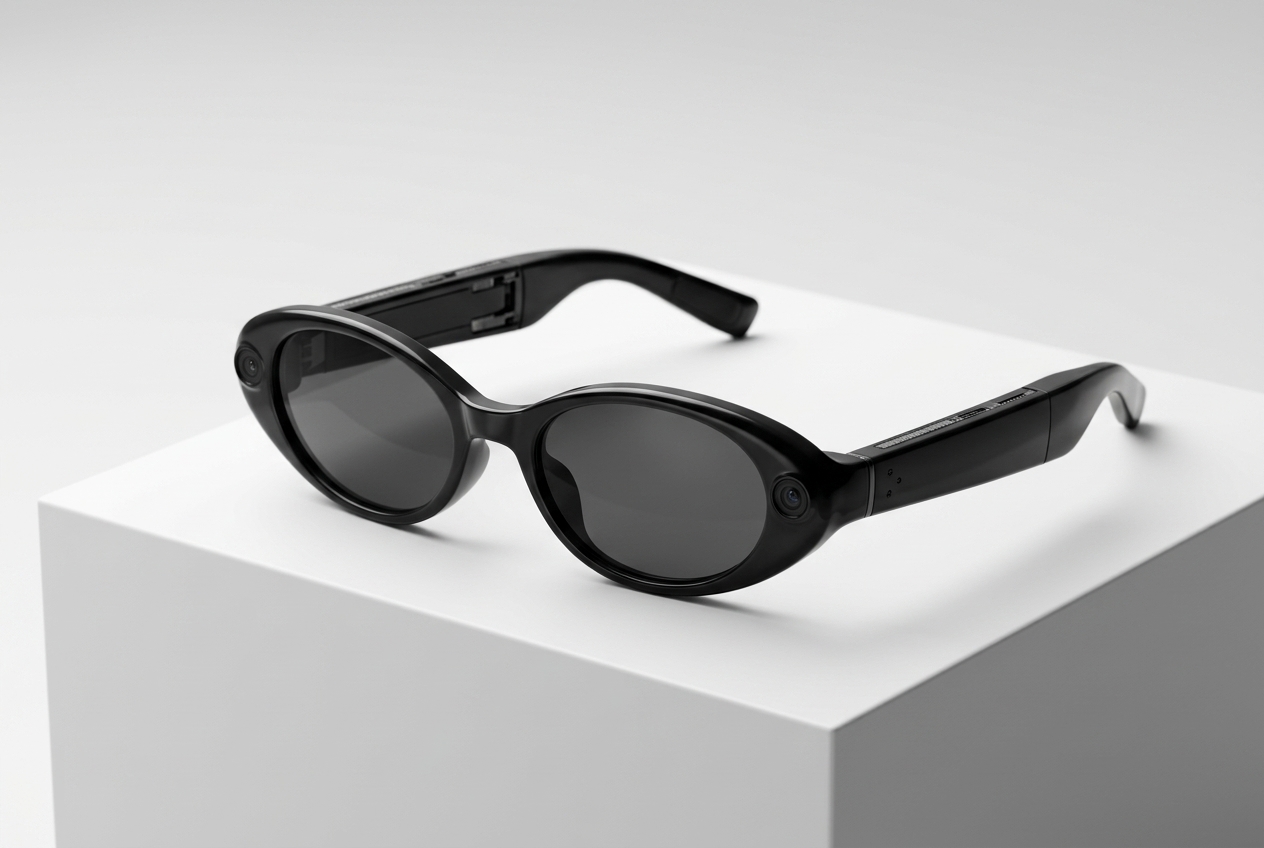
To kill that awkwardness, Samsung and Google brought in two eyewear names: Gentle Monster, the Seoul label whose bold, sculptural frames have become a fixture in K-pop and streetwear circles, and Warby Parker, the direct-to-consumer brand you've probably already bought a pair from. The two results have clearly different personalities.
| Category | Gentle Monster | Warby Parker |
|---|---|---|
| Style | Fashion-forward, chunky horn-rim lines | Classic, traditional eyeglass shape |
| Vibe | Trend-driven statement piece | Safe and familiar |
| Camera lens | Blended in more cleanly | Lens sits noticeably more proud |
They do share one trait: thick temple arms. Batteries, speakers, and a chipset all have to live in there, so the sides are meaningfully beefier than a normal pair. Both front corners of the frame carry a camera lens that "reads" whatever you're looking at.
Bottom line: both versions land closer to a well-designed fashion accessory than a piece of consumer electronics.
What can Gemini actually do here?
The real engine inside Galaxy Glass is Google Gemini. Your voice and your gaze cover a surprising amount of ground without ever unlocking your phone.
In practice, that looks like this.
- Calls and texts: Place a call or fire off a message without holding your phone.
- Missed-message summaries: Gemini condenses the notifications you missed and reads them back.
- Open-ear speakers: Nothing plugs your ears, so you hear music and prompts while staying aware of traffic and conversation.
- Live place info: Walk past a restaurant and pull up its reviews on the spot.
- Real-time translation: Look at a foreign menu or street sign and hear it in English. Voice translation that preserves the speaker's tone and inflection is supported too.
- Turn-by-turn navigation: No looking down at a screen. It reads your location and the direction you're facing and whispers the next turn in your ear.
- Photo and video capture: One button grabs whatever is in front of you.
- AI photo editing: Say "put hats on these people" about a shot you just took and Google's Nano Banana handles the edit on the fly.
The step beyond that is Gemini Intelligence. With your phone still in your pocket, Gemini can open your delivery app and load up your usual coffee order, leaving you to confirm it through the glasses. Your voice and your eyes do the work your hands used to.
How intuitive are the controls?
All the features in the world don't matter if the controls are a chore, because that's how a device ends up in a drawer. Galaxy Glass runs primarily on "Hey Google" voice commands, with touch gestures added for the places where talking out loud isn't an option.
If you've used a pair of wireless earbuds, you already know this language.
| Temple touchpad | Function |
|---|---|
| One-finger swipe forward | Next track |
| One-finger swipe back | Previous track |
| Two-finger swipe | Volume |
| Single light tap | Pause / answer a call |
| Physical camera button | Function |
|---|---|
| Short press | Take a photo |
| Long press | Start recording video |
| Press again | Stop recording |
No waking your phone screen. Just a quick swipe along the frame.
Charging follows the earbud playbook too. Take the glasses off, drop them in the dedicated case, and they charge automatically. There's an LED on the outside of the case, Galaxy Buds style, so you can check the battery without opening the lid.
How do the specs compare to the competition?
The standout component is the camera. Samsung is expected to use Sony's 12MP IMX681 sensor, and the headline is autofocus, something Meta's glasses don't have.
This camera isn't there to shoot pretty landscapes. It's the "eye" that lets the AI accurately read the objects and text you're looking at. Which means the ability to lock focus automatically translates directly into how accurate Gemini's answers are.
Here's the rest of what we know about the hardware.
| Spec | Detail |
|---|---|
| Camera sensor | Sony IMX681, 12MP |
| Focus | Autofocus supported |
| Lenses | Photochromic, tinting to match ambient light |
| Battery | Roughly 155mAh |
| Processor | Qualcomm Snapdragon AR1 |
Expect the lenses to shift smoothly from clear indoors to sunglass-dark outside, the way Transitions lenses do.
What stops someone from filming you?
The biggest obstacle for smart glasses isn't technical, it's privacy. This is a camera strapped to a face all day, so the "is that person recording me right now?" anxiety comes with the territory.
Ray-Ban Meta went through exactly this. Read enough smart glasses reviews and the same complaint shows up every time: you can't tell whether the person across from you is filming.
Meta's answer was to force an LED on whenever the camera is active, and Galaxy Glass takes the same route. The moment a photo or video starts, an LED on the front of the frame lights up immediately so the people around you can tell the camera is running.
When can you buy it, and for how much?
Which leaves the most practical question: timing and price.
| Item | Detail |
|---|---|
| Launch window | Second half of this year (fall) |
| Additional reveal | Possible surprise appearance at Galaxy Unpacked in London on July 22 |
| Expected price | $379–$499 |
Four hundred dollars is easy to flinch at, so run the math for a second. Keep these for three years and you're at roughly 35 to 45 cents a day. That's a fraction of the coffee you already buy every morning.
Of course, those 40 cents only feel worth it if this becomes something you reach for several times a day. The price sits right around Ray-Ban Meta territory, which most people read as reasonable for a first-generation device. Final US pricing could still shift before launch, and carrier or retailer bundles may change what you actually pay.
Could this be what comes after the smartphone?
Handling navigation, translation, photos, and even ordering with a word or a tap is genuinely impressive. It takes the work your phone was doing and moves it onto your face.
Whether those flashy features actually dissolve into daily life is something nobody can promise before wearing them for a month. First-generation breakthrough devices ending up as expensive drawer filler is hardly rare. Still, with Samsung, Google, and Apple all pushing into this category at once, the signal is clear: the smartphone's successor is heading for your face.
Before you hit buy, ask yourself one question. Do I find pulling my phone out annoying enough to pay $400 to stop doing it? Your answer is the whole review.