You've probably been here: you buy a small fan for your desk, and within two weeks it's shoved in a drawer because the cord was always in the way or the motor whined like a hair dryer. What most of us actually want is something quiet enough to run all summer, light enough to carry from the desk to the nightstand to the bathroom counter, and good-looking enough that it doesn't cheapen the setup. If you landed here searching for the Lumena Fan Stand 3Z, that's probably the exact tradeoff you're stuck on. So instead of rattling off spec-sheet numbers, I pulled together what actual owners say and sorted out whether this thing solves the problem.
What the Lumena Fan Stand 3Z Actually Is
The short version: a cordless personal desk fan built to run a long time between charges. It has a 4,000 mAh battery inside, and Lumena rates it at up to 20 hours on the lowest speed from a full charge. It charges over plain USB-C, which matters more than it sounds — you can top it off with the same brick and cable you use for your laptop or phone, so there's no proprietary adapter to lose. (It's a Korean brand, so in the US you'll usually find it through Amazon third-party sellers or import shops rather than at Target.)
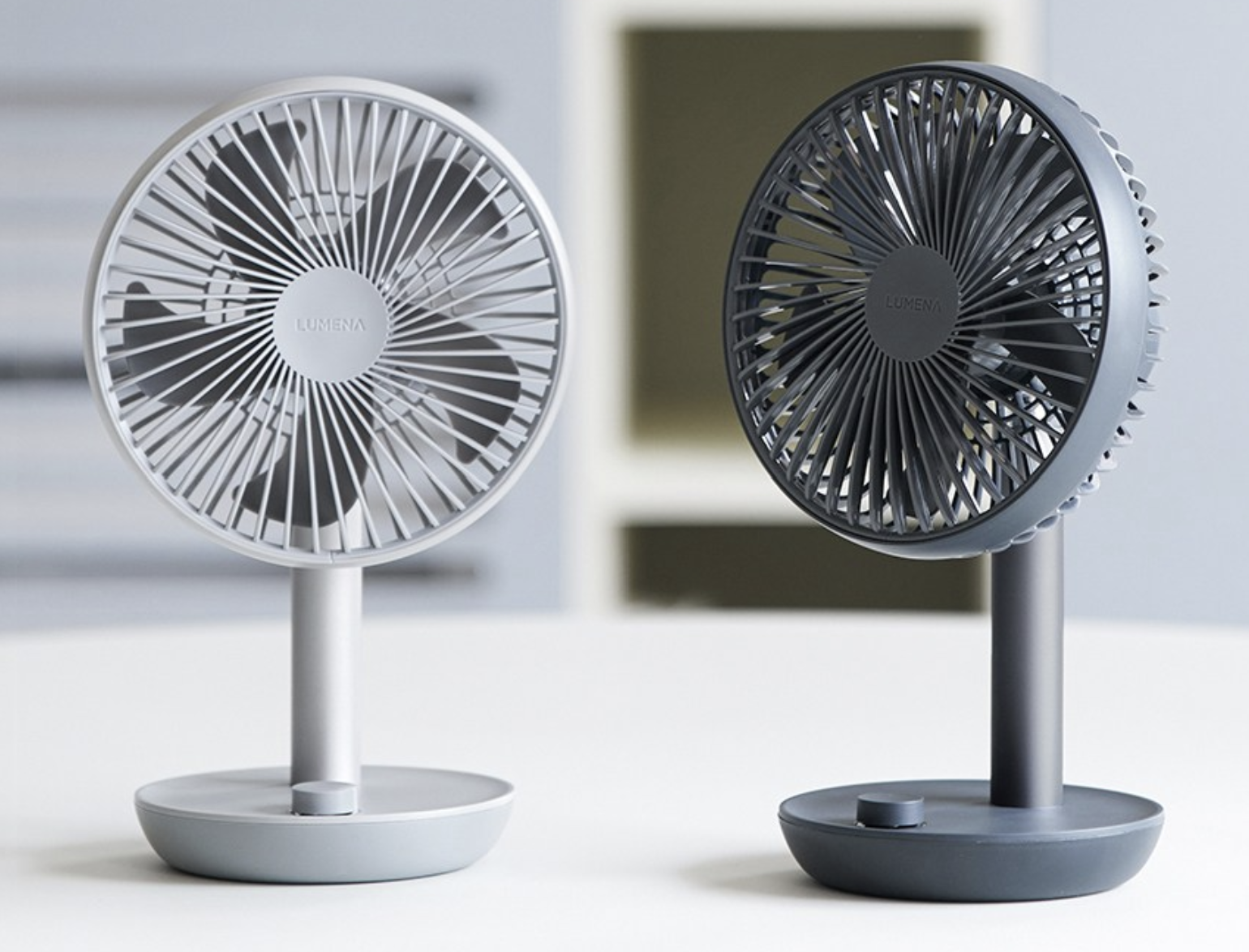
The motor is BLDC (brushless). That reads like marketing filler, but there's a real-world payoff people notice: the most common line in owner reviews is that speed 1 is basically inaudible and you don't really hear airflow until speed 2. Brushless motors also run cooler, so leaving it on for hours doesn't cook the housing. The blade assembly is a 5-blade, 6-inch (15 cm) unit with left-right oscillation and adjustable tilt. At roughly 1.1 lbs (500 g), it's a one-hand carry.
All the controls live in a single jog dial on the body. You twist and press it to cycle speed, timer, and oscillation — that's the whole interface. Reviewers bring this up constantly: there's no cluster of tiny buttons to decode. Add a hanging strap or a tarp clip and you can suspend it overhead as a makeshift air circulator, which is why it shows up a lot in camping and car-camping setups.
What Owners Consistently Like
Read enough reviews and the praise clusters into three buckets.
It's genuinely quiet — far and away the most cited plus. On low, people report it doesn't distract during video calls or study sessions, and it's the kind of quiet you can leave running all night in a still bedroom.
No cord means no friction — desk in the afternoon, nightstand at bedtime, bathroom counter in the morning. There's no outlet to hunt for and no cable to route, so the desk stays clean. That freedom comes up over and over.
Design and build quality — it doesn't look like a toy sitting on a desk, and the seams and finish hold up to a close look. If you care about how your gear looks, this is where it earns its price.
The jog dial gets its own share of compliments. "One control does everything, and that's actually easier" is a recurring sentiment. Owners also agree the airflow is plenty for one person at close range.

The Downsides, Stated Plainly
It isn't a do-everything fan. A few things are worth knowing before you pay.
"Up to 20 hours" is a speed-1 number. Turn the speed up and switch on oscillation and runtime drops noticeably. If you plan to run it on high all day, don't expect anything close to 20 hours.
It gets loud on high. Low is impressively quiet, but at max speed you clearly hear both the motor and the air. Some owners also say speed 1 isn't as dead-silent as they'd hoped. Think "low-noise," not "silent."
The grille doesn't come apart, so cleaning is a chore. You're wiping dust off the interior with a damp cloth through the guard. If you like fully disassembling a fan and washing the blades, this will bug you.
It won't cool a room. This is tuned for close-range personal airflow. Ask it to move air through a living room and you'll be disappointed.
Most of that falls under "fine once you know it." That last point is the real dealbreaker, though — if you're shopping for a fan to cool an actual room, this is the wrong category of product, not just the wrong model.
Who It Fits — and Who Should Pass
Good fit | Bad fit |
|---|---|
Anyone who wants quiet, personal airflow at a desk or bedside — apartment dwellers, remote workers, dorm rooms | Anyone shopping for a main fan to cool a whole living room |
People who move a fan around the house all day | People who always use it next to an outlet and don't need cordless |
Campers and car campers who'd also use it as a hanging circulator | People who insist on fully disassembling the blades to wash them |
Anyone who cares how their desk gear looks | Anyone who ranks max airflow and cooling power above all else |
Is It Worth the Money?
Expect to pay somewhere around $28–$30 (roughly ₩40,000 at retail in Korea), and more if you're buying through an importer. That's clearly above the $15 mini fans stacked by the register. But what you're paying for isn't airflow — it's the combination of low noise, cordless freedom, real battery life, and a design you don't mind looking at. People who specifically wanted that combination tend to say it earned its keep, and there are long-term owners reporting several summers of use before anything failed.
Flip that around: if your bar is "blows air, costs little," this is more fan than you need and you should buy something cheaper. One more practical note — don't just pay the first listed price. Seller conditions vary a lot on imported gear, and end-of-season sales and two-pack bundles show up regularly. Five minutes of comparison usually saves real money.
If what you've been hunting for is a quiet, cordless fan for your own personal space, the odds of regret here are low. If you were hoping to cool an entire room, look at a tower or pedestal fan instead. Match it against the "good fit" column above, and you'll know which one you are.